Quick Answer
Labradorite is a plagioclase feldspar known for labradorescence — flashes of blue, gold and green that appear from inside the stone rather than on its surface. In traditional crystal practice it is associated with intuition, protection, and steadiness through change, which is why it is often called the Stone of Transformation.
It sits at 6–6.5 on the Mohs scale and has perfect cleavage in two directions — a detail that matters more for daily wear than its hardness number suggests. This guide covers both the mineralogy and the tradition, and is clear about which is which.
What Labradorite Actually Is
Labradorite belongs to the plagioclase feldspar series, with the chemical formula (Ca,Na)(Al,Si)₄O₈. It crystallises in the triclinic system and has a specific gravity of roughly 2.68–2.72.
It was first identified on the Labrador peninsula in Canada in the 18th century, which is where the name comes from. Today, according to geological references including Mindat and geology.com, the main commercial sources are:
| Source | Typical character |
|---|---|
| Labrador, Canada | Type locality — blues and greens most common |
| Madagascar | Strong labradorescence, wide colour range — most bracelet material |
| Ylämaa, Finland | Spectrolite — full spectrum including reds and oranges |
| Russia, Ukraine, USA | Commercial production, variable quality |
How Labradorescence Actually Works
Most crystal guides describe the flash as "iridescence" and move on. The mechanism is more specific than that, and knowing it makes you much harder to sell a fake to.
The colour is not reflected off the surface. Light enters the stone, travels inward, strikes internal twinning layers, and reflects back out. The colour you see is the light returning from those internal layers.
Those layers are called the Bøggild intergrowth — microscopically thin alternating lamellae of two slightly different plagioclase compositions (roughly An₄₇ to An₅₈) that separate out as the mineral cools slowly over geological time. Because the spacing of these layers is comparable to the wavelength of visible light, they produce thin-film interference, the same physics that makes an oil film on water show colour.
Two practical consequences:
- Different layer thicknesses reflect different colours. Thicker lamellae tend toward red and gold, thinner toward blue. This is why one piece can flash several colours in different patches.
- The effect is angle-dependent. The flash appears and disappears as you tilt the stone, because you are changing the angle at which light meets those internal layers. A painted or coated imitation cannot do this.
Labradorescence vs Moonstone's Glow
These two are constantly confused, including by sellers.
| Labradorite (labradorescence) | Moonstone (adularescence) | |
|---|---|---|
| Appearance | Sharp, distinct flashes in patches | Soft, uniform glow that floats |
| Colour | Multiple spectral colours | Usually a single blue-white sheen |
| Cause | Lamellar twinning, thin-film interference | Light scattering between feldspar layers |
If the glow is soft and moves like a cloud, it is moonstone behaviour. If it snaps on and off in bright patches as you tilt, that is labradorite.
Spectrolite — and Why the Label Is Often Misused
Spectrolite is not a different mineral. It is a trade name for labradorite from the Ylämaa deposit in south-eastern Finland, named by the director of the Geological Survey of Finland. What distinguishes it is the completeness of the colour range: alongside the usual blues and greens, Finnish material reliably produces reds, oranges and deep golds — the full spectrum in a single stone.
The buyer warning: the name is now applied loosely. Many retailers label any colourful labradorite as spectrolite, and specimens from other localities are routinely sold under the term. Genuine Finnish spectrolite commands a significant premium and is a collector material — it is very unlikely to appear in a low-priced bracelet.
If a seller offers "spectrolite" at ordinary labradorite prices, what you are almost certainly buying is good Madagascan labradorite. That is a perfectly good stone — just not what the label claims.
The Care Detail Most Guides Miss: Cleavage
Labradorite's Mohs hardness of 6–6.5 sounds reasonably durable. But hardness measures resistance to scratching, not to breaking — and labradorite has perfect cleavage in two directions, meeting at about 86 degrees.
In plain terms: the stone has natural planes along which it splits cleanly. A sharp knock at the wrong angle can cause a flat break rather than a chip, even though the stone resists everyday scratching well.
This is why labradorite beads sometimes fracture on a single impact when a harder-scratching stone would only mark. Remove it before physical work or sport, and do not store it loose where it can knock against other beads.
Labradorite Meaning and Traditional Associations
Everything above is measurable mineralogy. What follows is tradition — and it is worth saying plainly that these are cultural and spiritual beliefs, not tested effects.
Labradorite is most consistently associated with:
- Intuition — trusting your own read on a situation
- Protection — traditionally described as shielding the aura, particularly for people who feel drained by others
- Steadiness through change — transitions rather than excitement
- Mental clarity — cutting through confusion when there are too many options
- Creativity — breaking out of repetitive thinking
Where the Sources Disagree
Crystal literature is not consistent about labradorite, and honest guides should say so rather than picking one version and stating it as fact.
- Chakra: Most sources link labradorite to the Third Eye and Crown. Some assign it to the Heart and Solar Plexus instead. There is no authority that settles this.
- Zodiac: Different sources name Leo, Scorpio, Sagittarius, or say it suits all signs equally. Unlike some stones in Vedic tradition, labradorite has no established rashi restriction.
- Alternative names: You will also see it called the Aurora Borealis Stone and the Stone of Mysticism.
Where sources conflict this openly, the honest conclusion is that these are interpretations rather than established positions.
A Note on Health Claims
Several crystal websites state that labradorite "balances the digestive system", "stimulates the immune system", or "regulates hormonal disorders", and some claim it relieves headaches, menstrual cramps or rheumatism.
There is no evidence for any of this. Labradorite is a feldspar mineral. It has no demonstrated physiological effect. Treat those claims as marketing, and never delay medical care on the strength of them.
What crystals can reasonably support is intention, focus and mindfulness — which is a real and useful thing, and does not need exaggerating.
Who Tends to Choose Labradorite?
- People in transition — a new job, a new city, the end of a relationship, starting a business
- Empaths and highly sensitive people — anyone who feels wrung out after being around a lot of people
- Professionals in high-pressure roles — where decisions have to be made quickly
- Creative workers — writers, designers and artists who feel stuck in a loop
- Meditation practitioners — often used to deepen intuitive practice
How to Wear a Labradorite Bracelet
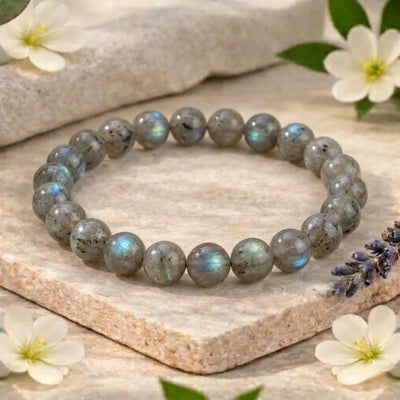
The Labradorite Crystal Bracelet is the most common way to keep the stone with you through the day.
- Left wrist — traditionally the receiving side, chosen for protection, calm or intuition. The more common choice for labradorite.
- Right wrist — traditionally the projecting side, chosen for confidence and outward expression.
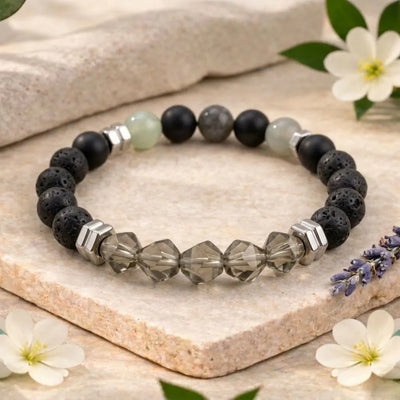
There is no strict rule. For a stronger protective combination, labradorite pairs well with black onyx and smoky quartz — which is what the Protection Bracelet combines.
Labradorite Beyond Bracelets
Larger pieces show the flash far better than 8mm beads, because a bigger cleavage surface catches more light at once.
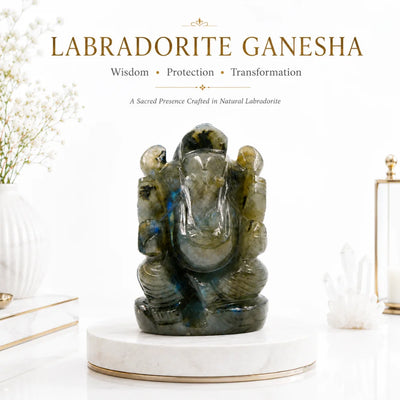
- Labradorite Ganesha Idol — traditionally placed facing the North-East.
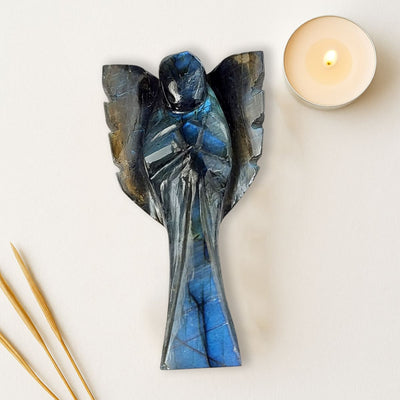
- Labradorite Angel — a small 5 cm figurine for a bedside table or meditation corner.
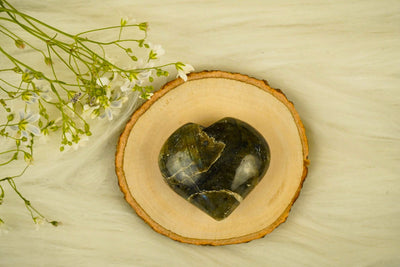
- Labradorite Heart — 5.5 × 5 cm palm stone, sized for holding during meditation.
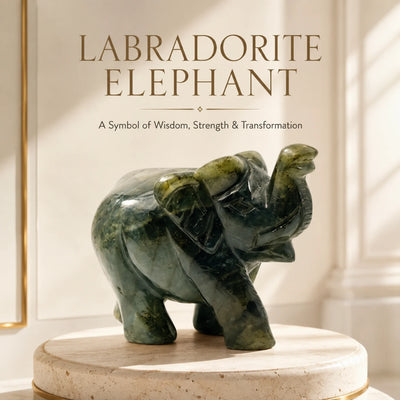
- Labradorite Elephant Figurine — hand-carved, with the raised trunk that traditionally symbolises welcoming opportunity.
- Labradorite Tea Light Candle Holders — candlelight passing through the stone brings out the iridescence particularly well.
See the full range in the Labradorite Collection.
How to Tell If Labradorite Is Real
Labradorite is one of the easier stones to verify, because the flash is difficult to fake convincingly.
- Tilt it slowly under a strong light. Labradorescence is strongest under direct sunlight or a bright LED torch. On real labradorite the colour travels across the surface and switches off entirely at some angles. Dyed or coated imitations hold their colour no matter how you turn them.
- The flash should look like it is under the surface, not sitting on top of it. A film effect is a coating.
- Some beads showing no flash at all is normal. The Bøggild lamellae are not uniformly distributed through the rough, so a natural bracelet will always have quiet beads. Perfect flash on every single bead is a warning sign, not a quality sign.
- Look for the grey base. Genuine labradorite has a grey, grey-green or near-black body colour. A bright, uniformly coloured stone is likely dyed.
- It stays cool and has weight. Glass and resin warm quickly in the hand.
For a broader walkthrough across stone types, see our real vs fake crystals identification guide.
How to Cleanse and Care for Labradorite
- Cleansing: Sage or incense smoke, moonlight overnight, or resting it on a selenite plate. Avoid salt water — it dulls the polished surface over time.
- Daily care: Remove before swimming, bathing, or applying perfume.
- Impact: Because of the cleavage planes described above, take it off during sport or physical work.
- Storage: A soft pouch, kept away from harder stones like quartz, tiger eye and aquamarine, which will scratch it.
Which Crystals Pair Well With Labradorite?
- Black Tourmaline — for a stronger protective combination
- Amethyst — calm alongside intuition
- Clear Quartz — traditionally used to amplify intention
- Moonstone — a natural pairing, though note the two look similar and are often confused
If you are choosing between labradorite and malachite — both are called the Stone of Transformation — the short version is that malachite is associated with the decision to change, labradorite with staying steady while change happens.
Frequently Asked Questions
What causes the flash in labradorite?
Thin-film interference within the Bøggild intergrowth — microscopically thin alternating layers of two plagioclase compositions that form as the mineral cools. Light reflects off these internal layers, which is why the colour appears to come from inside the stone and changes as you tilt it.
What is the difference between labradorite and spectrolite?
Spectrolite is a trade name for labradorite from the Ylämaa deposit in Finland, showing the full colour spectrum including reds and oranges. It is the same mineral. The term is widely misapplied to any colourful labradorite, so treat cheap "spectrolite" with caution.
Is labradorite the same as moonstone?
No. Both are feldspars but the optical effects differ. Labradorite shows sharp, multi-coloured flashes in patches (labradorescence). Moonstone shows a soft, uniform blue-white glow that seems to float (adularescence).
How hard is labradorite?
6–6.5 on the Mohs scale, with a specific gravity of about 2.68–2.72. However it also has perfect cleavage in two directions meeting at roughly 86 degrees, so it can split cleanly on impact despite resisting scratches reasonably well.
Which hand should I wear a labradorite bracelet on?
The left wrist is the more common choice, traditionally the receiving side, suiting labradorite's protective and intuitive associations. The right wrist is chosen for outward confidence. Neither is wrong.
Can labradorite go in water?
Brief contact is not harmful, but avoid it. Repeated exposure dulls the polish and salt water should be avoided entirely. Use smoke, moonlight or a selenite plate instead.
Does labradorite lose its flash over time?
No. The effect comes from the internal lamellar structure, not a surface treatment, so it cannot fade or wear off. If the stone looks dull, it usually needs wiping with a soft dry cloth.
Which zodiac signs can wear labradorite?
Sources disagree — Leo, Scorpio and Sagittarius are commonly named, while other sources say it suits all signs. There is no established rashi restriction on labradorite.
Is labradorite good for anxiety?
Many people wear it during stressful periods for its calming associations, and as a mindfulness prompt that can genuinely help. It is not a treatment. If anxiety is persistent or affecting your daily life, please speak to a doctor or a qualified mental health professional.
Sources and Further Reading
The mineralogical information on this page — composition, hardness, specific gravity, cleavage, the Bøggild intergrowth mechanism, and locality data — is drawn from standard gemmological and geological references including geology.com, Mindat.org, and published material on Finnish spectrolite from the Ylämaa deposit. The traditional and spiritual associations are drawn from crystal healing literature and are presented as belief, not fact.
Final Thoughts
Labradorite is a genuinely remarkable mineral even before you get to the metaphysics — a stone that produces colour through internal physics rather than pigment is not a common thing.
Judge it on that, buy it knowing what the flash is and how to test it, and treat the traditional associations as the meaningful ritual they are rather than as medicine.
Explore the full Labradorite Collection, or read our guide on how to choose the right healing crystal if you are still deciding.
Disclaimer: Crystal meanings described here are based on traditional beliefs and spiritual practices. They are not a substitute for medical, financial, or professional advice.
Shop the products in this guide
Natural stones, free delivery and cash on delivery across India.