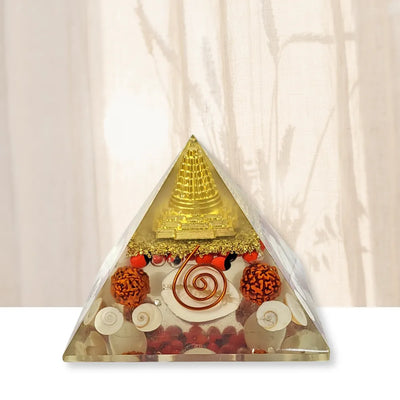
Orgonite is a handmade material made by casting resin with metal pieces (often a copper coil or metal flakes) and usually crystals, shaped into pyramids, spheres, pendants, coasters or tree bases. The idea comes from "orgone", a life energy proposed by psychoanalyst Wilhelm Reich in the 1930s, which science has never been able to detect. In crystal and Vastu-style practice, orgonite pyramids are kept on desks, in puja corners and near entrances as symbols of balance and positive intention. There is no evidence that orgonite blocks EMF or changes the energy of a room.
This guide explains what orgonite is made of, where the idea came from, the main types, what tradition says, what science says, how to choose a well-made piece and how to care for it.
What is orgonite made of?
Most orgonite has three or four ingredients, set in a mould and cast as one solid piece:
- Resin: a clear epoxy or polyester resin that holds everything together and gives the piece its glossy finish.
- Metal: copper, brass or aluminium shavings, metal flakes or a copper coil. In orgonite tradition, the metal is the "inorganic" part of the mix.
- Crystals: chips or small stones such as pyrite, black tourmaline, amethyst, clear quartz, lapis lazuli or green aventurine. They decide the colour and the traditional meaning of the piece.
- Symbols (optional): many Indian designs add a Shri Yantra, Om, rudraksha, gomti chakra or shankh, which turns the piece into a devotional object as well as a decor piece.
Because it is cast, every orgonite piece is a man-made object containing natural materials. The crystals inside can be natural, but orgonite itself is not a mineral or a crystal.
Where does the idea come from? Orgone and orgonite
Orgone was a term coined by the Austrian psychoanalyst Wilhelm Reich, a former student of Freud, in the late 1930s. Reich believed orgone was a universal life energy. In the 1940s he built "orgone accumulators", boxes of alternating organic and metal layers that he claimed could collect it.
- 1954: after an investigation by the US Food and Drug Administration, a federal court ordered the accumulators and related literature to be destroyed and banned their interstate shipment.
- 1956–1957: Reich was convicted of criminal contempt for violating the court's injunction. He was imprisoned in 1957 and died in prison later that year.
The modern resin-and-metal recipe called orgonite came much later. It is usually credited to hobbyists in the 1990s and early 2000s, most often to Don and Carol Croft, who popularised small resin pieces made with metal shavings and quartz. That is the form sold today.
Orgone vs orgonite: "orgone" is the energy Reich proposed; "orgonite" is the resin material. Sellers use both words for the same products, so an "orgone pyramid" and an "orgonite pyramid" are normally the same thing.
Types of orgonite
| Type | What it is | Where people use it |
|---|---|---|
| Orgonite pyramid | The classic form: a square-based pyramid with crystals, metal and often a symbol | Desk, puja corner, living-room shelf, entrance table |
| Orgone ball (sphere) | A polished resin sphere, usually on a small stand | Decor shelf, meditation corner |
| Orgonite pendant | A small cast pendant with a copper spiral | Worn as jewellery |
| Orgonite coaster or plate | A flat disc or pair of discs | Under a cup, or to rest bracelets and small stones on |
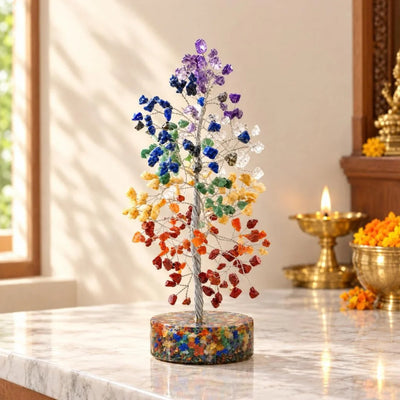
| Crystal tree with orgonite base | A wire crystal-chip tree set into a cast orgonite base | Gifting, Vastu decor, office desks |
What do orgonite pyramids mean in tradition?
- Balance and positive intention: in orgonite practice, the mix of resin, metal and crystal is believed to turn "negative" energy into positive. This is a belief, not a measured effect.
- The pyramid shape: pyramids carry their own long symbolism of stability and focus. The pyramid is one of the most widely recognised orgonite designs and is often used as a Vastu-style decorative object.
- The crystal decides the theme: pyrite for prosperity and work, black tourmaline for grounding and protection, amethyst for calm, green aventurine for luck, and seven-chakra mixes for overall balance.
- Devotional symbols: a Shri Yantra, Om, rudraksha or gomti chakra gives the piece a puja or meditation role.
For a stone-by-stone guide to the pyramids themselves, read crystal pyramids for home.

Does orgonite work? What science says
Here is the honest answer, because it matters before you buy.
- Orgone has never been detected. No scientific instrument has measured orgone energy, and Reich's experiments were not confirmed by other scientists.
- Orgonite does not block EMF. Mobile phones, Wi-Fi routers and laptops give off radio-frequency signals. Blocking them needs a continuous conductive enclosure, like a metal box around the device. A resin pyramid containing metal flakes is not a continuous conductive enclosure and should not be treated as an EMF-shielding device. If you are concerned about phone or Wi-Fi exposure, follow the guidance of official health and telecom authorities instead.
- No health effects have been shown. There is no evidence that orgonite improves sleep, reduces stress or treats any condition.
What orgonite genuinely offers is a handmade decor piece with natural stones set inside resin, and, for people who follow crystal or Vastu practice, a meaningful object to keep as a reminder of an intention. One practical advantage is real: encasing pyrite in resin can reduce its direct exposure to moisture, although it does not guarantee complete protection.
Where to keep an orgonite pyramid
- Work desk or study table: the most common spot, especially for pyrite pyramids, as a symbol of focus and growth.
- Puja or meditation corner: pyramids with a Shri Yantra, Om or rudraksha belong here. Many Vastu guides keep this corner in the north-east.
- Near the router or devices: many people keep one here as a reminder to take screen breaks. It will not change the signal, so treat it as decor.
- Entrance table: black tourmaline pyramids are traditionally placed near the main door as a symbol of protection.
- Shop or cash counter: pyrite and prosperity pyramids are a traditional choice where money changes hands.
Vastu and Feng Shui guides do not agree on exact directions for pyramids. Choose one convention, keep the piece on a clean, raised surface, and place it where you will see it every day.
How to choose a well-made orgonite piece
- Clear, smooth resin: the surface should be glossy and even. A few tiny bubbles are normal in hand-cast resin; large bubbles, cracks or a sticky surface are signs of poor casting.
- Visible, real stones: you should be able to see the crystal chips clearly. Ask the seller which stones are inside and whether they are natural.
- Flat, stable base: the piece should sit flat without rocking.
- Clear listing of materials: a good seller lists the resin, metal, stones and any symbols, plus size and weight.
- Honest claims: be cautious of sellers who promise EMF protection, cures or guaranteed wealth. Those claims are not supported.
How to care for orgonite
- Dust with a soft cloth: wipe with a dry or slightly damp soft cloth.
- No harsh chemicals: avoid alcohol, acetone, bleach and scouring pads, which can dull or cloud resin.
- Keep out of strong sunlight: many resins slowly yellow under UV light, and stones such as amethyst can fade.
- Avoid heat: do not leave orgonite on a car dashboard or near a stove; resin can soften or warp when very hot.
- Handle the points carefully: pyramid tips and edges can chip if dropped on a hard floor.
- Traditional cleansing: if you follow crystal practice, incense smoke or moonlight are gentle options. Avoid soaking the piece.
Orgonite vs a plain crystal: which should you choose?
| Orgonite piece | Plain crystal or crystal decor (cluster, tumble, tree) | |
|---|---|---|
| What it is | Man-made resin piece with stones inside | A natural mineral or a crystal-based decor piece |
| Look | Glossy, geometric, often with copper and symbols | Natural raw or polished stones; crystal-chip trees feature wire branches and a separate base. |
| Care | The resin can help reduce the stones' direct exposure to moisture and dust. | Depends on the stone (pyrite and selenite need to stay dry) |
| Best for | Desks, Vastu-style decor, devotional pieces, gifts | Collectors, meditation, and people who prefer natural minerals or crystal decor |
If you want the natural stone itself, see our amethyst cluster vs geode guide or the crystal clusters collection.
Shop orgonite at Calminds
Our pyramid collection includes orgonite pyramids for different intentions:
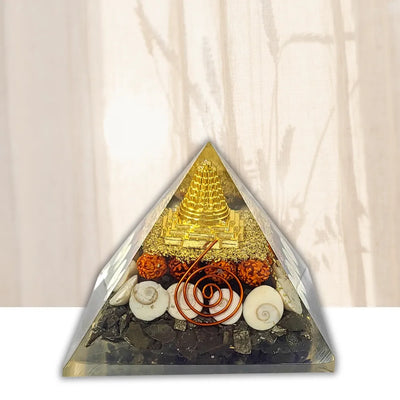
- Pyrite Orgonite Pyramid with Shri Yantra: an 8 cm cast pyramid with natural pyrite, a copper spiral, rudraksha, shankh and a gold-finish Shri Yantra.
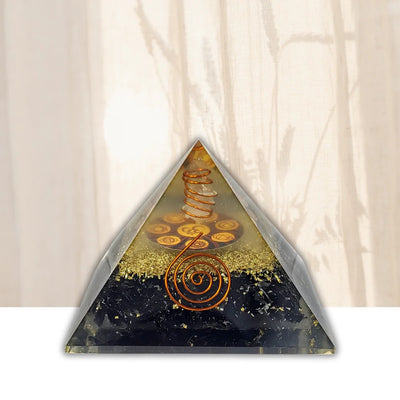
- Black Tourmaline Orgonite Pyramid: black tourmaline with a copper coil, a traditional entrance piece.
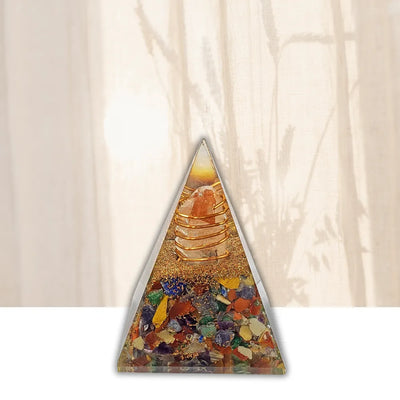
- 7 Chakra Orgone Pyramid: mixed chakra stones with a copper coil and gold flakes.
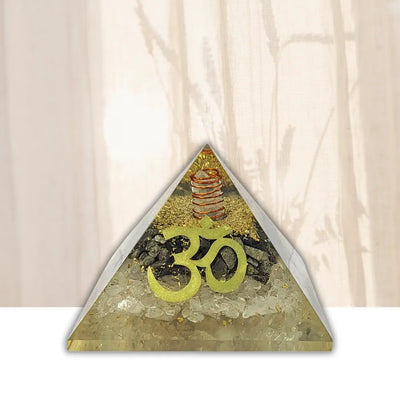
- Om Orgonite Pyramid: clear quartz and black tourmaline with a golden Om.
- Rudraksha & Gomti Chakra Orgonite Pyramid: rudraksha, gomti chakra and red jasper with a gold-plated stupa, for a puja corner.
Other orgonite pieces include the 7 Chakra Tree with Orgonite Base, the Pyrite Tree with Orgonite Base and the Pyrite Orgonite Coaster set.
Frequently Asked Questions
What is orgonite?
Orgonite is a man-made material made of resin, metal and usually crystals, cast into shapes such as pyramids, spheres and pendants. It is based on Wilhelm Reich's idea of "orgone" energy, which science has not confirmed.
What are the benefits of an orgonite pyramid?
In crystal and Vastu-style practices, orgonite pyramids are used as symbols of balance, protection and prosperity, depending on the stones and symbols inside. These are traditional beliefs, not proven effects. From a practical perspective, orgonite is a decorative piece, and its resin casing can help reduce the stones' direct exposure to moisture.
Does orgonite protect from mobile or Wi-Fi radiation?
No. There is no evidence that orgonite blocks or reduces EMF from phones, Wi-Fi or laptops. Shielding requires a continuous metal enclosure, which an orgonite pyramid is not.
What is the difference between orgone and orgonite?
Orgone is the life energy proposed by Wilhelm Reich. Orgonite is the resin-metal-crystal material made later. Sellers often use both words for the same products.
Is orgonite a natural crystal?
No. Orgonite is cast resin. The crystal chips inside can be natural, but the piece as a whole is man-made.
Where should I keep an orgonite pyramid at home?
Common places are a work desk, a puja or meditation corner, an entrance table and a shop counter. Keep it on a raised, clean surface out of strong sunlight.
Which orgonite pyramid is best for money?
In tradition, pyrite and "prosperity" pyramids are the usual choice for work and money intentions, often kept on a desk or cash counter. This is a symbolic choice and does not guarantee any financial result.
How do I clean orgonite?
Wipe it with a soft, dry or slightly damp cloth. Avoid alcohol, acetone and harsh cleaners, which can cloud the resin.
Does orgonite need charging?
Not in any physical sense. In orgonite tradition it is said to work without charging. If you follow crystal practice and like a cleansing ritual, incense smoke or moonlight are gentle options.
Read Next
- Crystal Pyramids for Home
- Where to Keep Pyrite Stone at Home
- Real Benefits of a 7 Chakra Crystal Tree
- Real vs Fake Crystals: Identification Guide
Sources for the history and science notes: Britannica – Wilhelm Reich; Encyclopedia.com – Wilhelm Reich trial (1956); Wilhelm Reich Museum – Biography (for Reich's background, not as scientific evidence); court record: Reich v. United States, 239 F.2d 134 (1st Cir. 1956).
Orgonite, crystal and Vastu meanings described here are traditional and spiritual beliefs, not proven effects. Orgonite is not a medical device and does not protect against radiation. Nothing in this article is medical, financial or professional advice.
Shop the products in this guide
Natural stones, free delivery and cash on delivery across India.