An amethyst cluster is a group of purple quartz crystals that grew together from one shared base. An amethyst geode is a rounded, hollow rock whose inside is lined with those crystals. Many clusters sold for the home are pieces of a geode. Both are natural quartz, coloured purple by traces of iron and natural radiation. In crystal tradition they are kept as a symbol of calm and reflection, usually in a living room, a meditation corner or on a desk, away from direct sunlight, which fades the colour. These are traditional associations, not proven effects.
This guide explains how a cluster and a geode differ, how they form, what they mean in crystal tradition, where to place one at home, how to tell natural amethyst from glass or resin, and how to care for it so the colour lasts.
What is an amethyst cluster?
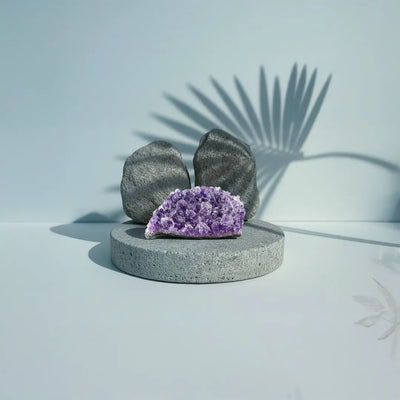
A natural amethyst crystal cluster is a group of crystal points growing outward from a common base (the matrix). Nothing is carved: the points are the shape the mineral took as it grew. Because of this, no two clusters are the same. Point size, colour depth and how densely the points are packed all vary.
Most amethyst clusters on the market are broken or cut from the wall of a larger geode. A sawn or polished base is common and normal; it is there so the piece can stand flat on a shelf.
What is an amethyst geode?
A geode is a rock with a hollow cavity inside, lined with crystals that grew inward from the walls. From the outside a geode stone can look like a plain grey or brown rock. When it is opened, the purple crystals show. Small geodes are sold as halves or "caves", and very tall ones, often called cathedrals, are sold as statement pieces.
Amethyst cluster vs geode: key differences
| Amethyst cluster | Amethyst geode | |
|---|---|---|
| Shape | Points fanning outward from one base | Hollow rock with points facing inward |
| Outside | Crystals visible from most sides | Rough rock shell; crystals only inside |
| Typical size | Palm-sized to shelf-sized | Small halves to floor-standing cathedrals |
| Best for | Desks, shelves, bedside tables and gifts | Living rooms, entrances, meditation rooms |
| Handling | Points exposed, so they chip more easily | The surrounding rock shell gives the inner crystals some physical protection during handling |
| Tradition | The same: both are amethyst and carry the same traditional associations | |
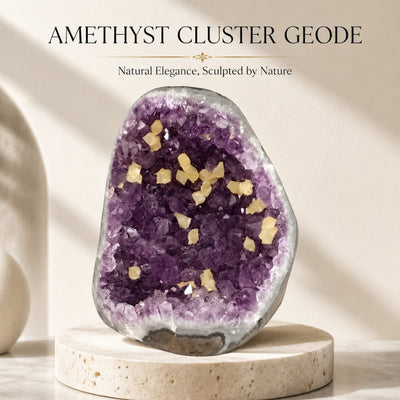
In short: if you want a piece where every crystal point is visible, choose an amethyst cluster. If you prefer a compact raw amethyst specimen with natural golden calcite inclusions, choose the Amethyst Cluster Geode.

How amethyst geodes form
Most amethyst geodes sold worldwide come from the Paraná basalts of southern Brazil and northern Uruguay (the Artigas region). These are ancient lava flows that cover a huge area of South America. Over a very long time, cavities opened inside the rock, and mineral-rich water moving through them slowly deposited quartz on the walls, layer by layer. The usual explanation is that the cavities began as gas bubbles in cooling lava. Recent research on the giant Uruguayan geodes (IUGS Geoheritage) suggests that many cavities formed later, after the basalt had been altered, with the water rising from deep in the basin. Geologists still debate the details.
The purple colour comes from traces of iron in the quartz that were changed by low-level natural radiation in the ground over geological time (GIA). That is why the colour is sensitive to heat and strong light (see care, below).
Amethyst at a glance
| Mineral | Quartz (silicon dioxide, SiO2) (Mindat) |
| Hardness | 7 on the Mohs scale; the points still chip if knocked |
| Colour cause | Trace iron altered by natural irradiation |
| Main sources | Brazil and Uruguay; Uruguayan material is often darker |
| Common inclusions | Calcite (white or golden), iron minerals such as goethite |
| Name | From the Greek amethystos, "not intoxicated" |
What does an amethyst cluster mean in crystal tradition?
- Calm and reflection: amethyst is traditionally called a "stone of peace" and is kept as a reminder to slow down.
- Spiritual practice: in modern crystal practice it is linked with the crown and third-eye chakras and is often used as a focus object in meditation.
- A "room" stone: because a cluster has many points facing outward, tradition treats it as a piece for a whole space rather than for one person. Bracelets are worn; clusters are placed.
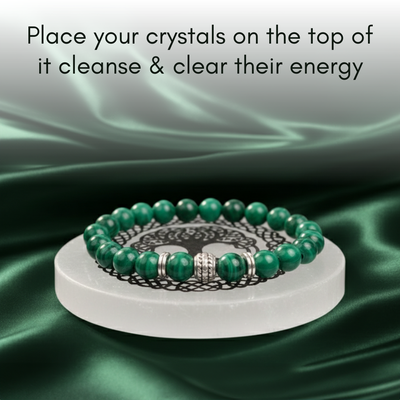
- Cleansing other crystals: some people rest tumbled stones or bracelets on a cluster or a selenite charging plate overnight as a symbolic "reset".
These meanings belong to spiritual tradition. There is no peer-reviewed evidence that amethyst cleanses a room, protects a space or changes sleep or mood. What a cluster genuinely gives you is a beautiful natural object that can act as a visual cue for a calm routine. For a closer look at what science and tradition each say about amethyst, read Is Amethyst Really a Healing Stone?
Where to place an amethyst cluster or geode at home
- Living room: the most common spot, and the classic way to use an amethyst crystal cluster as home decor. Use a shelf, console or side table where light is soft.
- Meditation or puja corner: as a focal object. Many modern Vastu guides suggest the north-east, the direction traditionally kept for prayer and meditation.
- Feng Shui wealth corner: in the widely used bagua map, purple is linked with the south-east (wealth) area, so some people keep an amethyst piece there. Feng Shui schools differ on how the bagua is applied.
- Bedroom: on a dresser or a shelf, not on the bed or under the pillow. Cluster points are sharp. Read crystals for sleep for what tradition suggests, and what it does not claim.
- Office or study desk: a small cluster works as a calm desk piece. Keep it at the back of the desk so it is not knocked.
- Entrance: a geode is sturdier than a cluster and suits an entrance table or a niche.
Where not to keep it: on a sunny windowsill, in a car, near a stove or heater, or in a bathroom where it may be splashed with cleaning products. If two Vastu or Feng Shui guides disagree on direction, that is normal. Pick one convention and keep the piece where you will see it every day. For more ideas, see best crystals for home.
How to choose a good amethyst cluster
- Colour first, size second. A small cluster with rich, even purple usually looks better on a shelf than a large pale one.
- Look at the tips. Clean, well-formed points with few chips are worth more. In many natural clusters the colour is deeper at the tips and paler towards the base, but this varies between specimens.
- Check the base. It should sit flat without rocking. A cut base is normal; heavy paint or glue on the base is worth asking about.
- Look for honest disclosure. The seller should say whether the base has been cut, whether anything has been repaired, and which inclusions are present.
- Weight and size. Sellers usually list weight. Compare pieces by weight and point quality, not by photos alone.
What decides the price? Colour depth and evenness, point quality and condition, size and weight, origin and how complete the piece is. Very cheap, very large, very evenly coloured "clusters" are a warning sign.
How to tell a natural amethyst cluster from a fake
- Too perfect: identical points, identical colour from tip to base and no inclusions at all are warning signs of glass or a moulded piece, though not proof on their own.
- Bubbles and mould lines: round air bubbles scattered through the crystal, or a seam line, point to glass or resin. Inclusions in natural quartz look different: tiny cracks, mineral flecks and very small fluid-filled pockets.
- Too light: resin is far lighter than quartz. A resin "cluster" feels noticeably light for its size; glass weighs about the same as quartz, so weight alone will not catch glass.
- Dye in the cracks: colour that collects in cracks, or a purple stain on the base, suggests dyed quartz.
- Natural signs: colour zoning, slightly different point sizes, small contact marks and mineral inclusions such as calcite are normal. They are signs of a natural specimen, not defects.
These signs help, but appearance alone cannot prove a piece is natural. For a valuable specimen, ask the seller for written details of the material, or have it checked by an independent gem-testing laboratory.
Please do not scratch-test or acid-test your cluster: it damages the piece, and calcite inclusions react to acids. For a full checklist across many stones, read our real vs fake crystals guide.

How to clean and care for an amethyst cluster
Because amethyst's colour comes from iron altered by radiation, heat and strong light can undo it. Long exposure to direct sunlight can slowly fade a deep purple to pale lilac, and the change is permanent. Heating fades it faster: at a few hundred degrees Celsius, amethyst can turn yellow to orange, with the result depending on the material and how it is heated (Scientific Reports, 2020). This is how most commercial citrine is made; read how heat-treated amethyst becomes citrine.
- Keep it out of direct sun: no windowsills, balconies or car dashboards.
- Dust with a soft, dry brush: a make-up brush or soft paintbrush reaches between the points; a cloth snags on them.
- Avoid soaking: a quick wipe is fine, but do not soak a cluster or geode, especially one with a cut base, a rock shell or calcite inclusions.
- No vinegar, acids or harsh cleaners: they can etch calcite inclusions and stain the base.
- Lift it by the base: never by the points, which are the fragile part.
- Traditional cleansing: if you follow crystal practice, moonlight, incense smoke or a selenite plate are the gentle options. Never use sunlight.
If a point does chip or a piece breaks, read a crystal broke, now what?
Amethyst cluster vs amethyst tree vs tumbles: which to choose?
| Piece | Choose it if you want |
|---|---|
| Cluster | A raw, natural piece for a shelf, desk or meditation corner |
| Geode | A compact raw amethyst specimen with natural golden calcite inclusions. |
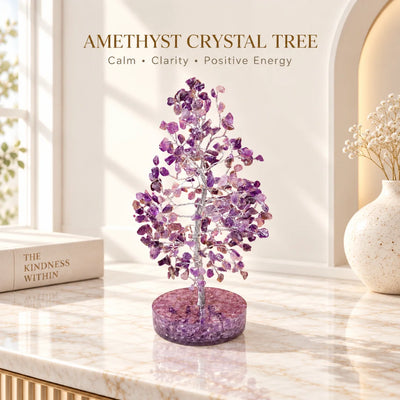
| Crystal tree | A decorative, Vastu-style gift piece made of tumbled chips (see amethyst crystal tree) |
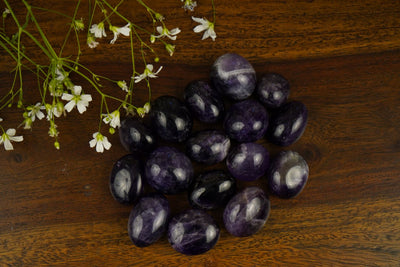
| Tumbled stones | Small pieces to carry, keep in a pocket, or use in a crystal grid |
| Bracelet | Something to wear every day |
Shop amethyst clusters and geodes at Calminds
Our Natural Amethyst Crystal Cluster is raw and unpolished, with dense points on a natural base. It is available in three weights (under 160 g, under 180 g and under 300 g), and each piece is one of a kind. The Amethyst Cluster Geode is a compact specimen, about 7 cm high and 350 g, with natural golden calcite inclusions among violet points.
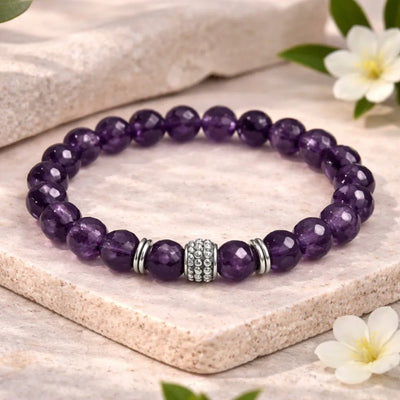
Browse all crystal clusters, or the full amethyst collection, which also includes the amethyst crystal tree, natural amethyst tumbles and the amethyst bracelet. To rest smaller stones on, the Tree of Life selenite charging plate is a common partner piece.
Frequently Asked Questions
What is the difference between an amethyst cluster and an amethyst geode?
A cluster is a group of crystals growing outward from one base. A geode is a hollow rock lined with crystals growing inward. Many clusters are pieces cut from a geode, so the mineral is the same.
Is an amethyst geode natural?
Yes. Genuine geodes form naturally inside rock, mostly in Brazil and Uruguay. Bases are often cut flat so the piece stands, which is normal. Watch out for glass or resin imitations with bubbles or identical points.
Where should I place an amethyst cluster at home?
Common places are a living-room shelf, a meditation or puja corner (many Vastu guides suggest the north-east) and a desk. Keep it away from direct sunlight and heat.
Can I keep an amethyst cluster in the bedroom?
Yes, many people do, on a dresser or shelf rather than on the bed, because the points are sharp. Tradition links amethyst with calm, but it is not a treatment for sleep problems.
Does an amethyst cluster fade in sunlight?
It can. Long exposure to strong sunlight slowly and permanently fades the purple. Keep it in soft indoor light.
How do I clean an amethyst cluster?
Dust it with a soft, dry brush. Avoid soaking it, and avoid vinegar or chemical cleaners, which can damage calcite inclusions and the base.
What are the amethyst geode benefits in crystal tradition?
In crystal tradition, amethyst is associated with calm, reflection and spiritual practice, and a geode is used as a focal piece for a room or meditation space. These are traditional beliefs, not proven effects.
Why is an amethyst cluster expensive?
Price depends on colour depth, point quality, size, weight and origin. A deep, even purple with clean points takes far longer to find than a pale or chipped piece.
Is a cut base a sign of a fake?
No. Most clusters are cut or ground flat at the base so they stand without rocking. A cut base is normal; glued-on fragments or painted bases are worth asking about.
Read Next
- Is Amethyst Really a Healing Stone? What Science and Spirit Say
- Rose Quartz vs Amethyst
- Real vs Fake Crystals: Identification Guide
- Gems vs Crystals: What Is the Difference?
Sources for the mineral and geology notes: Mindat – Amethyst; GIA – Amethyst; IUGS Geoheritage – Los Catalanes amethyst deposits, Uruguay; Scientific Reports (2020) – heat treatment of amethyst.
Crystal, Vastu and Feng Shui meanings described here are traditional and cultural beliefs, not proven effects. Nothing in this article is medical or psychological advice.
Shop the products in this guide
Natural stones, free delivery and cash on delivery across India.