Quick Answer
Malachite is a copper carbonate hydroxide mineral — Cu₂CO₃(OH)₂, roughly 58% copper by weight. That copper is responsible for its green colour, its unusual weight, and every safety rule that applies to it.
In traditional crystal practice it is known as the Stone of Transformation, associated with breaking old patterns, protection and emotional courage.
The practical rule: polished malachite is safe to wear. Malachite dust and malachite in water are not. Never soak it, never make elixirs with it. This guide explains exactly where the line sits and why.
What Malachite Actually Is
Malachite forms in the oxidation zone above copper deposits — the shallow layer where copper-rich solutions react with carbonate rock, usually limestone. This is why it is almost never found alone. Its usual companions are azurite, chrysocolla, cuprite and limonite, and mixed specimens are common.
| Property | Value |
|---|---|
| Formula | Cu₂CO₃(OH)₂ |
| Copper content | ~58% |
| Mohs hardness | 3.5–4 (soft) |
| Crystal system | Monoclinic |
| Streak | Pale green |
| Habit | Massive, botryoidal, stalactitic; concentric banding |
| Main sources | DR Congo, Russia (Urals), Zambia, Namibia, Arizona & Utah (USA), Australia |
At 3.5–4 it is one of the softest stones sold as jewellery — soft enough that a steel nail will mark it.
Why the Banding Is Never Repeated
The concentric rings are not decoration — they are a growth record.
Malachite deposits in layers as groundwater conditions fluctuate. Changes in copper concentration, pH, oxidation potential and trace impurities like iron, zinc or calcium each produce a slightly different layer. Denser, copper-richer layers appear dark green; leaner layers appear pale.
Because no two locations experienced the same sequence of conditions, the band pattern is effectively unique to each specimen — which is why it is used in gemmological identification and provenance work, and why every bead on a genuine bracelet looks different.
This is also the single most reliable way to spot a fake, as below.
Is Malachite Toxic? The Honest Answer
Malachite is roughly 58% copper. Copper is an essential nutrient in trace amounts, but copper salts — the soluble compounds that form when malachite breaks down — are toxic if ingested.
Two properties make malachite specifically riskier than most copper minerals: it is soft, so it powders easily, and it is reactive to moisture and acids, so water begins loosening copper compounds from the surface.
| Situation | Safe? | Why |
|---|---|---|
| Wearing a polished bracelet | Yes | Copper stays locked in the sealed, polished surface |
| Holding or handling a polished piece | Yes | No dust, no ingestion route |
| Soaking it in water | No | Damages the stone and can leach copper compounds |
| Making a direct elixir | No | Genuinely unsafe — never drink water a malachite has sat in |
| Cutting, carving or sanding it | No | Airborne dust is the real hazard; lapidary work requires wet-cutting and a respirator |
You will find sources online that flatly state malachite is water-safe and non-toxic. Given the mineral's softness, its solubility in acids, and the near-unanimous caution from lapidary and mineralogical references, the sensible position is to keep it dry. There is no benefit to soaking it that outweighs the risk.
How to Tell If Malachite Is Real
Malachite is one of the most heavily imitated stones, usually with dyed howlite or magnesite, resin composites, or reconstituted material made from malachite powder pressed with resin.
- The streak test — the most decisive check. Drag the stone across an unglazed ceramic tile (the unfinished underside of a tile works). Genuine malachite leaves a pale green streak. Dyed howlite leaves a white one. Very few sellers expect a buyer to know this.
- Read the banding. Real bands vary in thickness and intensity, curving into irregular rings, eyes and plumes. Dyed howlite looks flat and repetitive; reconstituted malachite looks smeared rather than sharply layered; printed imitations look suspiciously regular.
- Check the weight. At 58% copper, malachite feels noticeably heavier than quartz or jasper of the same size. Resin and plastic feel light.
- Feel the temperature. It stays cool for several seconds. Fakes warm up almost immediately.
- Look at the darkest zones. Genuine malachite's darkest bands are a deep forest green, not true black. Harsh black stripes suggest dye or print.
- Solid green with no banding is a warning sign — it may be dyed howlite or chrysocolla.
Reconstituted malachite is real malachite, just reconstructed — a legitimate product when disclosed. The problem is when it is not disclosed.
For a broader walkthrough, see our real vs fake crystals identification guide.
Malachite and Azurite
Azurite is malachite's blue counterpart — chemically almost identical, a blue copper carbonate (Cu₃(CO₃)₂(OH)₂), the same 3.5–4 hardness, and the same water sensitivity. The two grow together, and azurite slowly alters to malachite over geological time.
Worth knowing: "blue malachite" is a misleading trade name for azurite. Malachite is always green. If something is being sold to you as blue malachite, it is azurite — and it needs identical dry care.
Malachite Meaning and Traditional Associations
Everything above is measurable mineralogy. What follows is tradition, presented as belief rather than fact.
Malachite has a reputation for being direct. Where rose quartz is described as gentle, malachite is described as blunt — associated with bringing things to the surface rather than smoothing them over.
- Transformation — breaking repeated patterns you already know are not working
- Protection — historically carried by miners and travellers as a guarding stone
- Emotional courage — facing something you have been avoiding
- Confidence and growth — stepping into a bigger role or new venture
- Heart Chakra healing — releasing old emotional weight rather than suppressing it
The name itself comes from the Greek molochītis, "mallow-green stone", after the colour of mallow leaves.
In chakra work it is connected to the Heart Chakra (Anahata), sometimes to the Solar Plexus for its confidence associations. It is most consistently linked to Scorpio, though it is not restricted by rashi.
A Note on Health Claims
Some crystal sites claim malachite detoxifies the body, treats menstrual problems, or supports the liver. There is no evidence for any of this — and given that malachite is a copper mineral that is genuinely unsafe to ingest, claims about internal detoxification are worse than merely unfounded. Use it as a mindfulness tool. Never as a remedy.
Malachite vs Labradorite: Both Called the Stone of Transformation
Both nicknames are legitimate, but they describe different kinds of change.
| Malachite | Labradorite | |
|---|---|---|
| Type of change | Active — breaking a pattern you want to end | Passive — steadiness while change happens to you |
| Character | Direct, confronting | Protective, calming |
| Chakra | Heart | Third Eye (disputed) |
| Hardness | 3.5–4 (very soft) | 6–6.5 (moderate) |
Put simply: malachite is for the decision, labradorite is for the journey afterwards. If you are unsure which stage you are at, labradorite is the gentler starting point. For calm rather than confrontation, aquamarine fits better.
Who Tends to Choose Malachite?
- Anyone stuck in a repeating pattern — the same argument, the same career loop
- People starting something significant — a business, a move, leaving a long-held job
- Those working on emotional honesty — particularly people who suppress rather than address
- Scorpios — the sign most consistently linked to it
A caution repeated across crystal traditions: malachite is described as an intense stone. Many practitioners suggest not wearing it continuously at first — start with a few hours a day.
How to Wear Malachite
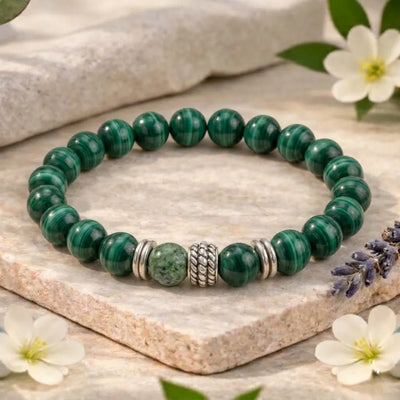
The Malachite Crystal Bracelet (8mm) is the standard everyday form.
- Left wrist — traditionally the receiving side, for protection and emotional healing. The more common choice.
- Right wrist — traditionally the projecting side, for confidence and outward action.
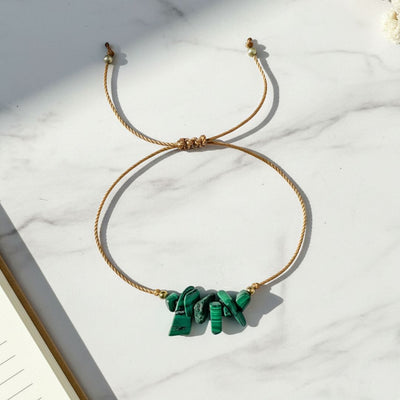
If you were born under Scorpio, the Scorpio Zodiac Bracelet pairs the stone with that sign. For a lighter option at an entry price, the Malachite Thread Bracelet uses an adjustable thread.
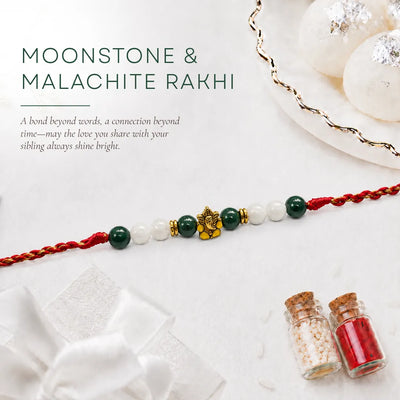
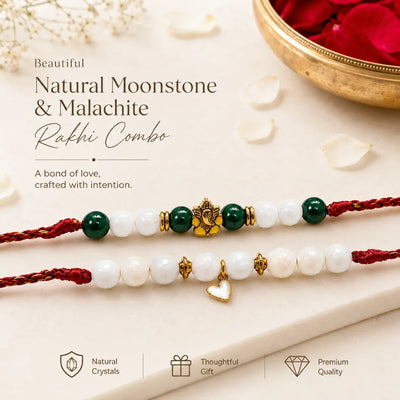
Malachite also appears in gifting pieces — the Moonstone & Malachite Ganesha Rakhi and the Moonstone & Malachite Rakhi Combo, both pairing it with moonstone for a balance of courage and calm.
How to Care for Malachite
- Never use water. Not for cleansing, not for charging, not for rinsing. Remove it before showering or swimming.
- Cleanse dry: sage or incense smoke, moonlight, sound, or a selenite plate.
- Sunlight is fine. Unlike amethyst or aquamarine, malachite's colour is lightfast — it does not fade in sunlight. Moonlight is still the more common choice by convention, not necessity.
- Avoid acids and household cleaners. Malachite dissolves in acid. Keep it away from vinegar, lemon, and bathroom cleaners.
- Store separately in a soft pouch. At 3.5–4 it will be scratched by almost every other stone, including quartz, aquamarine and tiger eye.
- Never sand, drill or cut it yourself. This is the one genuinely dangerous use.
Which Crystals Pair Well With Malachite?
- Moonstone — softens malachite's intensity with calm and intuition
- Rose Quartz — compassion alongside the harder work of transformation
- Black Tourmaline — a stronger protective combination
- Clear Quartz — traditionally used to amplify intention
When stacking, keep malachite on a separate wrist from harder stones so they do not grind against it.
Frequently Asked Questions
Is malachite toxic?
Malachite is about 58% copper and can be harmful if its dust is inhaled or if it is ingested. Wearing or handling a polished piece is safe — the copper stays locked in the sealed surface. The risks are dust from cutting, and water contact.
Can malachite go in water?
No. Malachite is soft and reacts with moisture and acids, which both damages the stone and can loosen copper compounds. Never soak it and never use it to make elixirs.
Does malachite fade in sunlight?
No. Malachite's green is lightfast and does not fade with light exposure — it has remained stable in oil paintings for centuries as a pigment. Its vulnerabilities are water, acid and physical softness, not sunlight.
How can I test if my malachite is real at home?
The streak test is the most decisive. Drag it across an unglazed ceramic tile: real malachite leaves a pale green streak, dyed howlite leaves white. Also check that the banding varies in thickness and that the stone feels heavy and cool.
What is reconstituted malachite?
Genuine malachite ground to powder and pressed with resin into a solid form. It is real malachite in composition, but the banding looks smeared rather than sharply layered. Reputable sellers disclose it.
Is blue malachite a real thing?
No. Malachite is always green. "Blue malachite" is a misleading trade name for azurite, a closely related blue copper carbonate that needs the same dry care.
Which zodiac sign should wear malachite?
Malachite is most closely linked to Scorpio, matching that sign's association with depth and transformation. It is not restricted by rashi.
Can I wear malachite every day?
You can, but many practitioners suggest easing in because it is traditionally described as an intense stone. It is also very soft, so remove it during physical work, washing and sport.
Sources and Further Reading
The mineralogical information here — composition, copper content, hardness, streak, banding formation, and toxicity guidance — draws on standard mineralogical and lapidary references, including pigment-conservation data on malachite's lightfastness. Traditional and spiritual associations are drawn from crystal healing literature and are presented as belief, not fact.
Final Thoughts
Malachite is not a subtle stone, and it is not usually the first one people buy. It tends to appeal to someone who already knows what needs to change.
Buy it knowing three things: the banding should never repeat, the streak should be pale green, and it never goes in water.
Explore our crystal bracelets, or read our guide on how to choose the right healing crystal.
Disclaimer: Crystal meanings described here are based on traditional beliefs and spiritual practices. They are not a substitute for medical, financial, or professional advice. Safety information on copper content is provided for practical care guidance.
Shop the products in this guide
Natural stones, free delivery and cash on delivery across India.