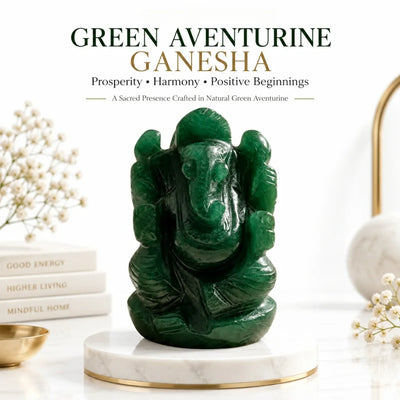
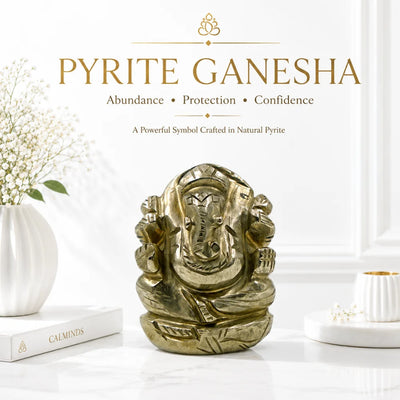
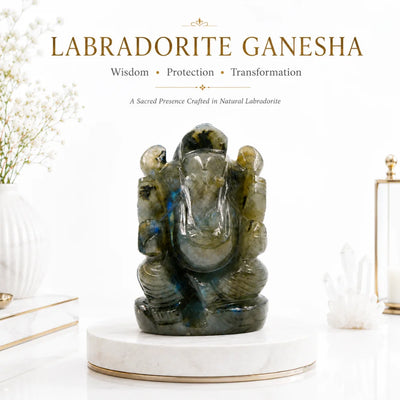
Quick Answer: Ganesh Chaturthi 2026 falls on Monday, 14 September 2026, with visarjan on Friday, 25 September 2026. A crystal Ganesha idol is a sthayi (permanent) idol — it is installed in the home mandir and worshipped year after year, never immersed. That makes it a lasting gift, not a replacement for the clay murti families immerse. For homes, choose a left-trunk (Vamamukhi) idol. Green Jade is traditionally chosen for prosperity, Rose Quartz for family harmony, Pyrite for business growth, and Labradorite for protection.
Every September, the same confusion plays out in Indian homes.
Someone brings home a beautiful crystal Ganesha. Ten days later, the family is standing at the visarjan queue wondering whether this one goes into the water too.
It does not. And understanding why changes how you choose, gift, and care for a stone idol entirely.
This guide covers the 2026 dates and muhurat, the permanent-versus-immersion distinction most gift guides get wrong, the ongoing PoP regulation debate that is pushing families toward stone idols, which crystal suits which intention, what the trunk direction genuinely means, Vastu placement, and how to tell real stone from resin before you pay for it.
Ganesh Chaturthi 2026: Dates and Muhurat

| Event | Date | Day |
|---|---|---|
| Ganesh Chaturthi (Sthapana) | 14 September 2026 | Monday |
| Madhyahna Puja Muhurat | Approx. 11:00 AM – 1:30 PM | — |
| Ganeshotsav | 14–25 September 2026 | 10 days |
| Ganesh Visarjan (Anant Chaturdashi) | 25 September 2026 | Friday |
Ganesh Chaturthi is observed on Bhadrapada Shukla Chaturthi — the fourth day of the waxing moon in the month of Bhadrapada. Because the Hindu calendar is lunisolar, the date moves each year between mid-August and late September. In 2025 it fell on 27 August; in 2026 it falls almost three weeks later.
Sthapana is traditionally performed during the Madhyahna muhurat, the midday window believed to be when Ganesha was born.
Muhurat timings shift by city. Check your local panchang for exact sthapana timings in your location.
Ordering note: For courier delivery before 14 September, order by the first week of September. Stone idols ship with heavy protective packaging and move slower through transit hubs. Corporate and bulk orders with custom branding need six to eight weeks.
Why More Families Are Choosing Permanent Stone Idols
There is a reason the crystal Ganesha market in India has grown sharply, and it is not only aesthetic.
The Central Pollution Control Board's revised guidelines, issued in 2020, prohibit the immersion of Plaster of Paris idols in natural water bodies, along with thermocol, single-use plastic, and toxic chemical dyes. The guidelines encourage idols made only from natural, biodegradable material — traditionally, clay.
Enforcement has been uneven. Several municipal bodies have run crackdowns on PoP idol manufacturing, while idol makers and mandals have argued in court that the guidelines are advisory rather than mandatory. As recently as 5 August 2026, the Bombay High Court was hearing a batch of petitions on the implementation of those guidelines, asking manufacturers to produce scientific material on whether PoP genuinely harms water bodies — while clarifying that the court was examining environmental concerns, not the religious practice of immersion itself.
For most families, the practical outcome is this: the clay murti remains the correct choice for the ten-day Ganeshotsav and visarjan, and a permanent stone or crystal idol has become the natural companion to it — one that stays in the mandir all year and never enters a water body at all.
This is worth being precise about, because a lot of online marketing muddles it.
Crystal Ganesha vs Clay Murti: The Distinction That Matters
The clay (mitti) murti brought home for Ganeshotsav is installed through pran-pratishtha, worshipped for a fixed period — one and a half, five, seven, or ten days — and then immersed. The immersion is not disposal. It is the completion of the ritual. The murti is meant to dissolve.
A crystal, stone, marble, or metal idol belongs to a different tradition entirely. These are installed as sthayi idols in the home shrine and worshipped continuously, year after year. They are never immersed.
So a crystal Ganesha is not an eco-friendly substitute for your visarjan murti, whatever some product pages suggest. Most families keep both: a permanent stone Ganesha in the mandir throughout the year, and a clay murti brought in specially for the festival days.
Because it stays, the same idol returns to use at Diwali, when Lakshmi and Ganesh are worshipped together on Lakshmi Puja night. Our guide to crystal Lakshmi Ganesh idols for Diwali pooja covers which stone pairs with which, correct placement on the altar, and why these idols are never immersed either.
This matters most when gifting. A crystal Ganesha is a gift of permanence — closer in spirit to a housewarming or wedding gift than to a festival sweet box. It will still be in that person's puja room in twenty years.
Which Crystal Ganesha Suits Which Intention
Crystal traditions associate different stones with different qualities. These are traditional and spiritual associations — not medical or financial guarantees — but they are what most buyers are choosing between.
| Stone | Traditionally associated with | Best gifted to |
|---|---|---|
| Green Jade | Prosperity, steady growth, harmony | New business owners, parents, in-laws |
| Rose Quartz | Love, family harmony, emotional healing | Newlyweds, siblings, a mother |
| Pyrite | Wealth, confidence, decisive action | Entrepreneurs, someone starting a venture |
| Labradorite | Protection, wisdom, transformation | Someone in a career or life transition |
| Tiger Eye | Courage, focus, grounding | Students, anyone facing a big decision |
- Green Jade is the most requested crystal Ganesha in India. In both Vastu and Feng Shui traditions, jade is associated with prosperity that builds gradually rather than arriving suddenly — which is why it is the default for a home mandir or a shop counter. Its deep green also holds up beautifully against brass and marble mandir interiors.
- Rose Quartz has become the wedding-season choice, associated in crystal tradition with the heart and with harmony between people sharing a home. Its soft pink reads warmer than jade in a bedroom or living-room shrine.
- Pyrite, with its metallic gold sheen, is the one people select for office desks and business premises. It carries the visual weight of a statement piece at a fraction of the size.
- Labradorite is the connoisseur's pick — its flash shifts colour as you move past it, which makes it the idol people remember receiving.
Browse the full range in the God Idols collection, or read our deeper guide on why the Green Jade Ganesha is so widely chosen.
Trunk Direction: What It Actually Means
Search this question and you will find a lot of alarming advice. Here is the measured version.
Left-curving trunk (Vamamukhi)
The form traditionally recommended for homes. The left side is associated with the Ida or Chandra Nadi, the cooling lunar channel, and the form is described as gentle and easily pleased. Nearly every household Ganesha you have seen has a left-turned trunk. When the trunk is shown reaching toward a modak or laddoo, tradition treats it as especially auspicious for material well-being.
Right-curving trunk (Dakshinabhimukhi or Siddhi Vinayak)
Associated with the Pingala or Surya Nadi, the solar channel. Tradition describes this form as more potent and more demanding: it is said to require disciplined, regular puja and a scrupulously maintained space. This is why right-trunk idols are found mostly in temples rather than homes.
Straight trunk
Rare in practice. Associated with Sushumna, the central channel, and with balance and meditative stillness.
One honest clarification most pages omit: this left-versus-right framework comes from Vastu and temple practice, not from classical scripture. The traditional iconographic texts classify Ganapati by named forms — Heramba, Nritta, Lakshmi Ganapati and others — and trunk direction is not one of their categories at all.
So if someone has gifted you a right-trunk idol, or you have already bought one, nothing is wrong and nothing needs correcting. The old warnings are best read as reminders to treat the idol with consistent care, not as prohibitions.
For gifting, choose left-trunk. It carries no ritual conditions, which means your gift never becomes an obligation for the person receiving it.
Where to Place a Ganesha Idol at Home
| Guideline | Recommendation |
|---|---|
| Direction | North-east (Ishaan) preferred; north, east and west acceptable |
| Facing | The idol should face north or east |
| Avoid | South-facing placement, bathroom-adjacent walls, under staircases |
| Height | On a chowki or mandir shelf — never directly on the floor |
| Number | One idol per shrine is the traditional recommendation |
| Posture | A seated (Lalitasana) Ganesha signifies stability — ideal for homes |
| Entrance | Two idols back to back — one facing outward, one inward |
A few practical points that get overlooked:
- Keep the idol at or above chest height when seated for puja, not below eye level.
- Do not place a Ganesha idol directly facing a bedroom door or a bathroom entrance.
- Avoid clutter on the same shelf. In every tradition mentioned here, cleanliness of the space matters more than any single placement rule.
For crystal placement across other product types, our Vastu crystal placement guide covers the same principles.
Ganesh Chaturthi Gift Ideas by Budget
Under ₹5,000 — extended family, colleagues, neighbours
The 3-inch certified Green Jade Ganesha and the Labradorite Ganesha sit here. Compact enough for a small mandir or office desk, substantial enough that it does not read as a token.
₹5,000 to ₹15,000 — parents, in-laws, close friends
The Pyrite Ganesha and the handcrafted Rose Quartz figurine belong to this band. Enough weight and stone character that the idol anchors a room rather than sitting quietly in it.
₹15,000 and above — milestone gifting
The 6-inch Green Jade Ganesha and larger Rose Quartz pieces. These are wedding, housewarming, and business-inauguration gifts — the kind that get remembered and mentioned years later.
Corporate and bulk gifting
For teams and client gifting, smaller idols with custom-branded packaging work better than a few large pieces. Details on the corporate gifting page.
What not to gift
A few things worth avoiding, since they come up often:
- Broken or chipped idols. Tradition treats a damaged idol as inauspicious to gift or install.
- Right-trunk idols to someone with an irregular puja routine. It creates an obligation they did not ask for.
- Multiple idols of the same deity for one shrine. One per shrine is the traditional norm.
- Leather-accented packaging. Avoided in puja contexts.
How to Tell a Real Crystal Ganesha From Resin
Resin and dyed-glass idols are widely sold as "crystal Ganesha", particularly below ₹2,000. Five checks before you pay:
- Weight. Natural stone is significantly denser than resin. A 3-inch jade idol should feel heavier than it looks. This is the single most reliable field test.
- Temperature. Genuine stone stays cool and warms slowly against the skin. Resin matches room temperature immediately.
- Natural variation. Real stone carries inclusions, colour banding, and small irregularities. Perfectly uniform colour with zero variation across a whole idol is a warning sign.
- Sound. Tapped gently with a fingernail, stone gives a short, dense sound. Resin sounds hollow and plasticky.
- Certification. For anything above ₹5,000, ask for a certificate identifying the stone. A seller unwilling to provide one for a premium piece is telling you something.
How Calminds verifies its idols
Every Calminds idol moves through the S.P.A.C.E. process before it ships:
- S — Sourced. Stone procured from verified suppliers, with material identity confirmed before carving.
- P — Purified. Each piece is cleansed before any energy work begins.
- A — Activated. Reiki activation performed by a certified Reiki Grandmaster.
- C — Crafted. Hand-finished, with natural variation preserved rather than polished out.
- E — Examined. Final inspection for chips, cracks and finish before dispatch.
Higher-value idols ship with a certificate of authenticity identifying the stone. Calminds is ISO 9001:2015 certified for quality management (Certificate No. CAF1Q0304V25), and every idol arrives in protective packaging designed for stone weight rather than generic parcel filler.
Caring for a Crystal Ganesha Year-Round
Because a stone idol stays with you permanently, it needs maintenance rather than immersion.
- Dusting: Dry, soft microfibre cloth. Avoid soap and chemical cleaners on porous stones.
- Water: Selenite and malachite should not be soaked. When unsure, wipe rather than wash.
- Energetic cleansing: Traditional methods include a selenite plate, sound, or brief indirect morning sunlight. Extended direct sun fades rose quartz and amethyst over time.
- Abhishek: For stone idols, use a damp cloth rather than pouring water, and dry immediately.
- Annual reset: Many families do a fuller cleaning of the mandir and idols before Ganesh Chaturthi and again before Diwali each year.
Our full guide on cleansing and recharging crystals covers method-by-method instructions.
Frequently Asked Questions
When is Ganesh Chaturthi in 2026?
Ganesh Chaturthi 2026 falls on Monday, 14 September 2026. The ten-day Ganeshotsav concludes with Ganesh Visarjan on Anant Chaturdashi, Friday, 25 September 2026.
Can I do visarjan of a crystal Ganesha idol?
No. Crystal, stone, marble and metal idols are installed permanently and worshipped continuously — they are not immersed. Only clay murtis brought specifically for Ganeshotsav are immersed. Many families keep a permanent crystal Ganesha in the mandir and bring a separate clay murti for the festival days.
Can the same crystal Ganesha be used for Diwali Lakshmi Puja?
Yes. Because it is a permanent idol, the same Ganesha stays in the mandir and is worshipped alongside Lakshmi on Diwali night. See our guide to crystal Lakshmi Ganesh idols for Diwali for altar placement and stone pairings.
Are PoP Ganesha idols banned in India?
The CPCB's 2020 revised guidelines prohibit the immersion of Plaster of Paris idols in natural water bodies and encourage natural, biodegradable materials instead. Enforcement varies by state and municipality, and the question of whether the guidelines are mandatory or advisory has been contested in court, including a Bombay High Court hearing in August 2026. Check your local municipal rules before purchasing an idol for immersion.
Which crystal Ganesha is best for home?
Green Jade is the most widely chosen for homes, traditionally associated with prosperity and harmony. Rose Quartz is preferred where family harmony is the intention. In all cases, choose a left-trunk (Vamamukhi) idol for household worship.
Is it auspicious to gift a Ganesha idol?
Yes. Gifting a Ganesha idol is traditionally considered auspicious, particularly for housewarmings, weddings, and business inaugurations. Ganesha is invoked as Vighnaharta, the remover of obstacles, at the start of any new undertaking.
Which direction should the Ganesha idol face?
The idol should face north or east, and is traditionally placed in the north-east corner of the home. South-facing placement is avoided in Vastu tradition.
Can I keep a right-trunk Ganesha at home?
There is no rule that a right-trunk idol causes harm. Tradition describes it as requiring more disciplined daily worship, which is why it is more common in temples. If your puja routine is regular, it is perfectly acceptable at home.
How many Ganesha idols should I keep at home?
Vastu tradition recommends one idol per shrine. The exception is the entrance, where two idols placed back to back are traditional — one facing outward, one inward.
Do crystal idols need pran-pratishtha?
Traditional practice involves pran-pratishtha performed by a priest for an idol installed in a home mandir. Calminds idols are Reiki-activated before dispatch, but formal installation rituals remain a personal and family decision.
How do I know a crystal Ganesha is real stone and not resin?
Check weight, temperature, natural variation, and sound. Natural stone is dense, stays cool, shows inclusions and colour banding, and gives a short solid sound when tapped. For pieces above ₹5,000, ask the seller for a certificate identifying the stone.
What is the best gift for Ganesh Chaturthi?
Traditional options include Ganesha idols, puja thalis, sweets and dry fruits. A crystal Ganesha idol is chosen when the intention is a lasting gift rather than a consumable one, since it remains in the home permanently.
How early should I order a Ganesh Chaturthi gift?
Order by the first week of September for delivery before 14 September. Stone idols require protective packaging and move slower in transit. Corporate and bulk orders with custom branding need six to eight weeks.
Choosing Your Idol This Year
Ganesh Chaturthi 2026 arrives on 14 September. Whether you are choosing for your own mandir or gifting, it comes down to three decisions: the stone that matches your intention, a left-turned trunk for household ease, and a seller who will tell you honestly what the stone actually is and put it in writing.
Explore the complete range in the God Idols collection, or browse Luxury Decor for larger statement pieces.
About Calminds
Calminds is an ISO 9001:2015 certified Indian crystal and spiritual wellness brand, established in 2024 and based in Delhi. Every piece is Reiki-activated by a certified Reiki Grandmaster through our five-step S.P.A.C.E. process, and higher-value pieces ship with a certificate of authenticity. Read our full story.
Crystal meanings and Vastu guidance described here are based on traditional beliefs and spiritual practices. They are not a substitute for medical, financial, or professional advice. Regulations on idol materials and immersion vary by state and municipality — verify local rules before purchase.
Shop the products in this guide
Natural stones, free delivery and cash on delivery across India.