Quick answer: Yes, a Laughing Buddha gift is considered auspicious in Feng Shui and is widely given in India for housewarmings, new offices and Diwali. The figure is Budai, a cheerful 10th-century Chinese monk, not Gautama Buddha. Keep it facing into the room, on a table or shelf, often in the south-east. It symbolises contentment; there is no evidence it brings money.
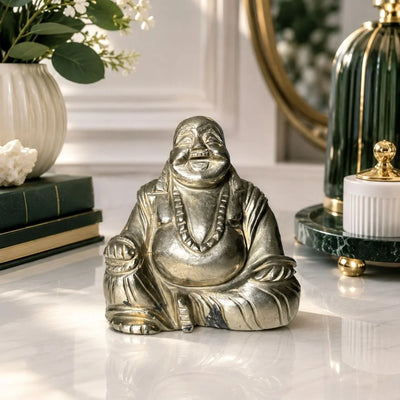
A Laughing Buddha gift is one of the few spiritual presents almost every Indian family understands at a glance: a round-bellied, smiling figure that wishes the home contentment without needing a card. It turns up at housewarmings, shop openings, promotions and, more than ever, at Diwali. At Calminds we carve ours in natural stone, like the Natural Pyrite Laughing Buddha (₹12,999), but before you buy any Laughing Buddha it helps to know who he is, what the poses mean, where tradition says to keep him, and what he honestly can and cannot do.
Is a Laughing Buddha a nice present idea?
Yes. According to Feng Shui tradition, the Laughing Buddha is a symbol of happiness, contentment and abundance, therefore gifting one is taken as a warm wish for the person's home or job. It's neutral enough for a client, cheery enough for family, and it works with just about any décor.
You will often hear that a Laughing Buddha only “works” when it is given as a gift. It’s a popular saying, not a rule from any Feng Shui source. It’s completely fine to buy one for yourself or to give one away.
A Laughing Buddha gift is particularly appropriate for these occasions:
- Griha pravesh or new home: A welcoming figure for the entrance or living room
- A new shop, clinic or office: for the reception or the owner’s desk. And that’s exactly what the Luxury Pyrite Laughing Buddha Set (₹13,499) has been made for.
- Dhanteras and Diwali: Many households buy one new auspicious item every Dhanteras to keep in the home.
- Retirement or a milestone birthday: the hands-up pose is all about celebration.
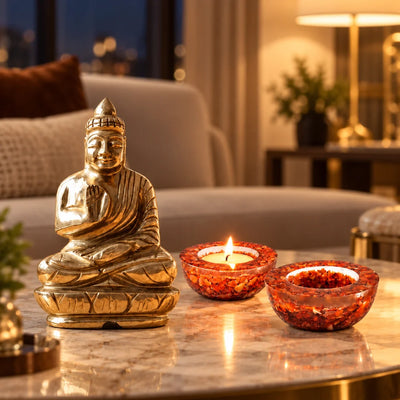
One thing worth knowing: a statue of Gautama Buddha is a sacred image, not a fortunate charm, if the person you are gifting is a practising Buddhist. The laughing Buddha is a different figure (more on that next) and a seated Buddha like our Pyrite Buddha Desk Set (₹8,999) is better gifted as a peaceful, respectful object, not with “for luck” attached.
Who Is the Laughing Buddha? Budai and Hotei
The Laughing Buddha is modelled after Budai, a Chinese Chan (Zen) monk who is said to have lived in the 10th century in what is now the province of Zhejiang. His name means 'cloth sack', after the bag he carried while he walked, and traditions depict him as cheery, generous and loving of children. He is half history, half legend, and what we know about him is half rumour.
Ultimately, Chinese Buddhism came to see Budai as an incarnation of Maitreya, the future Buddha, and some temples therefore position him at the door. In Japan, he is Hotei, one of the Seven Lucky Gods.
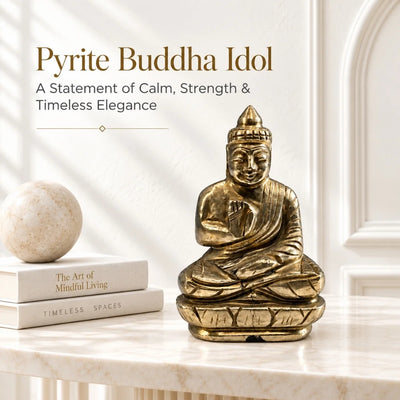
He is not the historical Buddha, Siddhartha Gautama. Gautama Buddha is often represented as thin and meditating with eyes half closed. If you’re after calm, not laughing, go for our Certified Pyrite Buddha Idol (₹9,299), that seated, meditative Buddha.
14 Kinds of Laughing Buddha and Their Significance
Each posture has a traditional meaning in Feng Shui and Chinese folk practice. The connotations differ between schools and sellers, so use the table as a guide to what each figure is meant to signify, then pick the wish you want to give.
| Pose or form | Traditional meaning | Thoughtful gift for |
|---|---|---|
| Carrying a sack | Gathering blessings and carrying away worries | A new home, someone relocating |
| Holding a gold ingot | Wealth and prosperity symbolism | A shop owner, a new business |
| Both hands raised | Joy, celebration and a happy household | Retirement, milestone birthdays, family homes |
| Sitting on a dragon | Success and authority (the dragon stands for power in Chinese symbolism) | A promotion, a team leader |
| Surrounded by children | Blessings for a growing family | New parents, a family home |
| Holding a gourd (wu lou) | Long life and good health symbolism | Grandparents and elders |
| Holding a fan or beads | Fanning away troubles; calm and mindfulness | A study, a meditation corner |
| Holding a bowl | Openness to receiving blessings; contentment with enough | Someone starting a spiritual practice |
| Sitting on a money frog | Wealth that stays in the home (the three-legged frog is a Feng Shui money symbol) | A cash counter, a trader |
| Riding or beside an elephant | Wisdom, strength and good fortune | A family home, a new venture |
| Sitting on a tortoise | Long life, stability and steady support | Elders, a long-term business |
| Holding a fish | Surplus and abundance ("fish" sounds like "surplus" in Chinese) | A housewarming, a restaurant |
| Travelling, with a stick and bundle | Safe journeys and protection on the road | Someone moving abroad or travelling for work |
| Sets of 3 or 6 | Several wishes together, often wealth, health and happiness (groupings vary by seller) | Larger homes, corporate gifting |
Laughing Buddha colours
Colour meanings vary by seller, but these are the common associations:
- Gold or brass: wealth and success — the most popular choice for shops and offices
- Red: good fortune and celebration in Chinese tradition
- Green: growth and health
- White or ivory: peace and purity, suited to a meditation corner
- Black: protection, usually placed near an entrance
- Natural wood or stone: stability and a calm, earthy look
Which Laughing Buddha statue is appropriate for home?
For a home, look for three things:
- A face you really like. The smile is the whole point. If the carving seems numb or sly, keep looking.
- A tranquil seated stance for living areas. The sack, ingot and hands-up symbols are particularly popular in Indian houses. Dragon figures are more formal and work well in offices.
- One size fits the place. A small one is lost on a big console and a big one needs a strong shelf. Most damaged or cracked figures are replaced rather than displayed.
Laughing Buddha Gift Material
| Material | Look and feel | Care | Best for |
|---|---|---|---|
| Natural pyrite | Heavy, metallic gold, no two carvings alike | Keep dry; wipe with a dry cloth only | A premium or milestone gift |
| Brass | Classic golden shine, solid weight | Tarnishes over time; polish now and then | Traditional homes and pooja-adjacent shelves |
| Resin or polyresin | Light, often painted, detailed | Can chip; keep out of strong sun | A budget-friendly first piece |
| Ceramic or porcelain | Glazed colours, smooth | Breaks if dropped | Display cabinets |
| Wood | Warm, hand-carved texture | Keep away from damp | Minimal, earthy interiors |
A quick tip on pyrite: real pyrite is very dense (the certificate on our Laughing Buddha records a specific gravity of 5.10), so a genuine carving feels surprisingly heavy for its size. A light "golden stone" figure is usually resin or painted metal.
Feng Shui Laughing Buddha: Direction and Placement
The second inquiry after “is it lucky” is the direction for a Laughing Buddha. The usual Feng Shui practice recommends:
- Facing the main door: often diagonally opposite the entrance, so he "greets" everyone who walks in.
- South-east: the traditional wealth corner in Feng Shui and in Vastu-inspired placement.
- East: associated with family and harmony in Feng Shui, a good spot for the hands-up or children figures.
- Office desk or reception: facing into the room or towards the door of your cabin.
- Height: on a table, console or shelf, around eye level or slightly below. Never on the floor.
Where to keep a Laughing Buddha, room by room
| Room | Where exactly | Pose that suits it |
|---|---|---|
| Entrance or foyer | On a console facing the main door | Sack or hands raised |
| Living room | South-east corner or diagonally opposite the door, at eye level | Sack, ingot or hands raised |
| Home office or study | On the desk, facing you or the door | Ingot, dragon or fan |
| Shop or cash counter | Beside the till, facing customers as they enter | Ingot or money frog |
| Office reception | Facing the entrance, on a raised surface | Dragon or sets of three |
| Children's room | On a shelf, facing the door | Surrounded by children |
| Meditation or pooja corner | Beside, never above, any deity murti | Beads, bowl or meditating |
| Dining room | On a sideboard where the family gathers | Sack or fish |
| Garden or balcony | Sheltered and raised, weatherproof material only | Any; never pyrite outdoors |
Never place a Laughing Buddha here
- In or facing a bathroom or toilet
- Directly on the floor
- On or next to a shoe rack
- Near the kitchen stove or in steam
- In a dusty, cluttered corner or behind a door
- Above a deity murti in the pooja room
- Cracked or chipped — tradition replaces a damaged figure rather than displaying it
Some families also avoid the bedroom. Customs vary from family to family, so follow your family's practice where it differs.
Laughing Buddha for money: the honest answer
In Feng Shui the Laughing Buddha is a symbol of abundance, and rubbing his belly "for luck" is a much-loved custom. Many people genuinely enjoy that little ritual, and there is nothing wrong with it.
But there is no evidence that any statue, in any material, brings money, wins clients or improves a business. A Laughing Buddha is a cultural symbol and a lovely object. What it can honestly do is sit where you see it every day as a reminder to stay cheerful and content while you work towards your goals. Please never treat a statue, ours included, as a financial plan or an investment.
Pyrite carries a similar tradition. It has been called the "merchant's stone" and is traditionally kept where money is handled, which is why a pyrite Laughing Buddha is popular with business owners. That is a tradition, not a measured property of the mineral. Our guide to wealth crystals explains these traditions in more detail.
Our Laughing Buddha gift picks for Diwali 2026
Natural Pyrite Laughing Buddha
Hand-carved from a single block of natural pyrite, 445 g, with a Gemstone Research Center gemmological report confirming the stone. It arrives in a hinged wooden gift box with a velvet interior. This is a one-of-a-kind carving and only one piece is available, so it is genuinely limited stock.
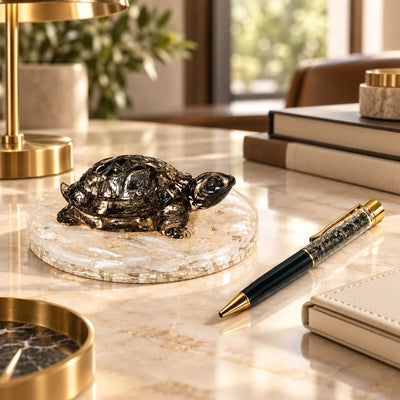
Luxury Pyrite Laughing Buddha Set
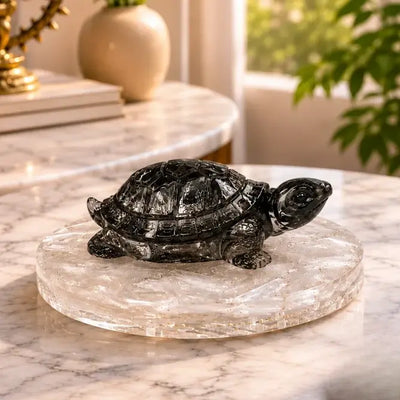
The certified 445 g pyrite Laughing Buddha with a pyrite Feng Shui turtle on a selenite plate and a black pyrite ball pen. Bought separately the three cost ₹15,597; the set is ₹13,499, which means the turtle and pen add only ₹500 over the Buddha alone. Only one set is available.
Pyrite Buddha Desk Set
A seated, meditative pyrite Buddha (not the Laughing Buddha) with a certificate identifying the stone, plus two carnelian tea light holders. It costs less than the idol bought on its own.
Thoughtful pyrite gifts under ₹3,500
If a carved idol is beyond the budget, pyrite desk pieces carry the same golden look and tradition:
- Shubh Labh Desk Set (₹2,199): pyrite turtle on selenite with a pyrite pen.
- Pyrite Feng Shui Turtle with Selenite Plate (₹1,299): the turtle on its own.
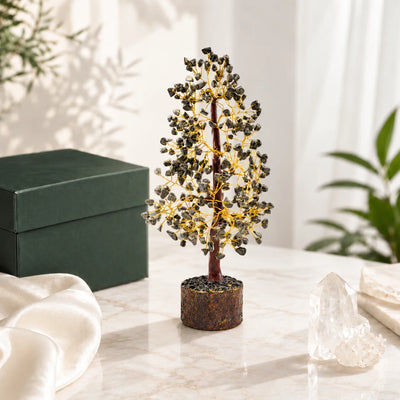
- Pyrite Energy Crystal Tree (₹2,099): 300 natural pyrite beads on a wooden base, about 25 cm tall.
- Pyrite Crystal Ball Pen, Black Edition (₹1,299): a metal signing pen topped with a pyrite ball.
- Shubh Labh Desk Set Premium (₹3,199): turtle, pen and orgonite pyramid for a client or boss.
Browse the full pyrite collection or the money and success collection for more. For corporate or bulk orders, email info@calminds.in or call +91 93190 94943.
Delivery for the festival: we deliver across India in 0 to 7 days, with free shipping on prepaid orders and cash on delivery available. Order by 30 October for Dhanteras (Friday 6 November) and by 1 November for Diwali (Sunday 8 November). Unused pieces in original packaging can be returned within 7 days. Our Diwali 2026 calendar has the full five days.
How to give and care for a Laughing Buddha
- Give it boxed and with both hands, ideally on Dhanteras, Diwali morning or the day of the housewarming.
- Pyrite stays dry: pyrite is iron sulphide and moisture slowly damages it. Wipe with a soft dry cloth, never rinse or soak it, and keep it out of bathrooms and steamy kitchens.
- If you rub the belly, wipe the pyrite afterwards, because hand cream and sweat dull the surface over time.
Frequently asked questions
Can we give Laughing Buddha as a gift?
Yes. In Feng Shui tradition a Laughing Buddha is an auspicious gift that wishes the receiver happiness and contentment, and in India it is commonly given for housewarmings, new businesses, promotions and Diwali. Choose the pose that matches your wish, such as the sack for a new home or the gold ingot for a shop, and include a short note on where to keep it.
Is it good to buy a Laughing Buddha for yourself?
Yes. The idea that a Laughing Buddha must be received as a gift is a popular saying, not a rule from Feng Shui texts. Plenty of people buy one for their own home or desk. What matters in tradition is keeping it clean, at a respectful height and in a cheerful, uncluttered place where you will see it every day.
Which direction should a Laughing Buddha face?
Common Feng Shui practice places the Laughing Buddha facing the main door, often diagonally opposite the entrance, so he greets people as they come in. The south-east is the traditional wealth corner and the east is linked with family harmony. Keep him on a table or shelf, never on the floor. Customs vary, so follow your family's practice.
Which Laughing Buddha is best for home?
For most homes, a seated Laughing Buddha carrying a sack or with both hands raised, placed in the living room facing the main door. Families with young children often choose the figure surrounded by children.
Which Laughing Buddha is best for money?
By Feng Shui tradition, the figure holding a gold ingot or sitting on a money frog is the one associated with wealth, usually kept in the south-east or beside the cash counter. It is a symbol, not a way to make money.
Does a Laughing Buddha gift bring money?
In Feng Shui the Laughing Buddha symbolises abundance, and rubbing his belly for luck is a popular custom. However, there is no evidence that a statue brings money or business. It is best understood as a cultural symbol and a cheerful reminder of contentment. Give it for its meaning and beauty, not as a financial remedy.
Where should we not keep a Laughing Buddha?
Most families avoid keeping a Laughing Buddha in the bathroom, on the floor, next to shoes, near the kitchen stove, or in a dusty, cluttered corner. Some also avoid the bedroom. For a pyrite figure there is a practical reason too: damp and steam slowly damage pyrite, so keep it in a dry room on a clean, raised surface.
Can I keep a Laughing Buddha in the bedroom?
Many families avoid it, because the figure is linked with activity and celebration rather than rest. If you do keep one there, choose a small, calm figure on a shelf rather than facing the bed.
What does a Laughing Buddha with children mean?
A Laughing Buddha surrounded by children is a traditional wish for a happy, growing family. It is a popular gift for newly married couples, new parents and family homes.
What should I do if my Laughing Buddha breaks?
Tradition says a cracked or chipped figure should be replaced rather than displayed. Many families thank it and immerse a clay or wooden figure in flowing water, or wrap a stone one in cloth and keep it away respectfully.
What is the difference between Laughing Buddha and Gautama Buddha?
The Laughing Buddha is Budai, a cheerful Chinese monk said to have lived in the 10th century, later regarded as an incarnation of Maitreya. Gautama Buddha is Siddhartha Gautama, the founder of Buddhism, usually shown slim and seated in meditation. The Laughing Buddha is a Feng Shui symbol of joy; Gautama Buddha is a sacred figure of calm.
Laughing Buddha ko ghar mein kis disha mein rakhna chahiye?
Feng Shui ke hisaab se Laughing Buddha ko main door ki taraf face karte hue rakhna sabse common hai, aksar entrance ke diagonally saamne. South-east disha ko wealth corner aur east ko family harmony se joda jaata hai. Unhe table ya shelf par rakhein, zameen par nahi. Har parivaar ki parampara alag hoti hai, apne ghar ki practice follow karein.
The bottom line
A Laughing Buddha gift is a warm, widely understood wish for happiness and contentment, and it suits homes, offices and Diwali gifting alike. Choose the pose for the wish you want to give, a material that will last, and a spot facing into the room. Love him for what he represents, not as a promise of money. If you want a piece that will still look special in twenty years, natural pyrite is hard to beat.
More guides: Pyrite stone: real vs fake and care · Dhanteras 2026: best crystals to buy · Corporate gifts for clients
Laughing Buddha, Feng Shui, Vastu and crystal meanings described here are traditional beliefs, not guaranteed effects. Prices are as of October 2026.
Shop the products in this guide
Natural stones, free delivery and cash on delivery across India.