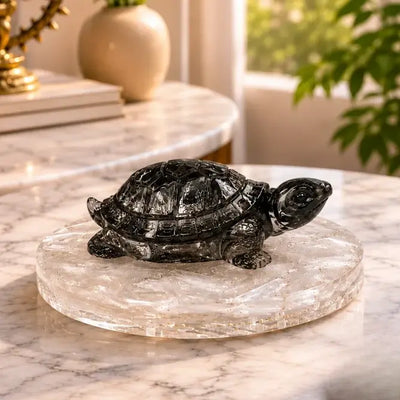
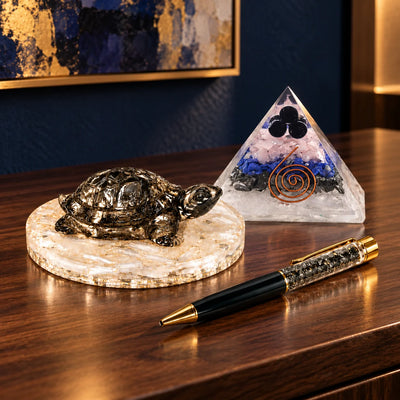
A feng shui turtle (tortoise, or kachua) is a traditional symbol of long life, steady progress, protection and support. Both Feng Shui and Vastu most commonly place it in the north of a home or office, on a raised, clean, dry surface such as a desk, entrance table or cash counter — never in a bathroom or on the floor. Some people keep a metal turtle in a shallow plate of water, but pyrite and selenite should always stay dry. These are traditional beliefs, not proven effects.
This guide explains what the feng shui turtle means, which direction it should face, where to keep a crystal tortoise at home or at work, which type of turtle suits which intention, and a common mistake people make with water.
What is a feng shui turtle?
In Chinese tradition the tortoise is one of the Four Celestial Animals that guard the four directions. The Black Tortoise (Xuanwu) guards the north and is linked with the water element, winter and the colour black — which is why the north is the turtle's traditional place in Feng Shui. Its long life made it a symbol of endurance, and its shell a symbol of shelter and protection.
India has its own deep connection with the tortoise. Kurma, Lord Vishnu's second avatar, took the form of a tortoise and held Mount Mandara on his back during the Samudra Manthan. In Vastu Shastra, a tortoise figure is kept in the home as a symbol of stability and steady growth. In India, the "feng shui turtle" sold today usually blends both traditions.
What does a feng shui turtle symbolise?
- Longevity — the tortoise is one of the longest-living animals, so it stands for a long and settled life.
- Steady progress — slow, patient growth rather than quick, risky gains.
- Support and protection — the shell is read as "backing": support behind you at work and shelter for the home.
- Stability — a grounded, calm household or workplace.
- Prosperity — the popular link with wealth comes mostly from the material (pyrite especially) and from keeping the turtle near a cash counter. In Feng Shui the turtle is best known as a symbol of support, protection and longevity; prosperity is a secondary association.
Whatever you choose it for, treat the turtle as a reminder of an intention — patience, stability or growth — and not as a guarantee of any result.
Which direction should a feng shui turtle face?
The most common advice in both Feng Shui and Vastu is to keep the turtle in the north part of the room, home or office. Beyond that, traditions differ, so it helps to know the main conventions:
- North: the most widely followed placement, linked to the Black Tortoise and to career and steady growth.
- North-west or north-east: some Vastu guides suggest north-west for metal tortoises and north-east (or east) for crystal ones.
- Behind you at work: in Feng Shui, a turtle placed behind your chair or at the back of your desk symbolises "support at your back".
- At the entrance: the most common Vastu convention is to keep the turtle's head facing into the home, as if walking in. Guides differ on the exact compass direction.
- Avoid the south: several Vastu guides advise against the south, which is associated with fire, for a water-linked symbol.
If two guides disagree, that is normal — they come from different schools. Pick one convention that makes sense to you and keep the turtle somewhere you will see it every day.
Where to keep a feng shui turtle at home and at work

- Office desk: the most popular spot. Keep it on the desk where you can see it, or behind you for the "support" idea.
- Shop or cash counter: a traditional place for a pyrite turtle, close to where money changes hands.
- Entrance table: near the main door, raised off the floor, facing into the home.
- Living room: on a shelf or console in the north part of the room.
- Study table: as a reminder of patient, steady effort.
- Bedroom: traditions differ here. Some people keep a rose quartz turtle on a bedside shelf, while some Vastu guides advise keeping tortoises out of the bedroom and kitchen altogether. If you follow that view, the living room is a good alternative.
Where not to keep it: in a bathroom, near a dustbin, directly on the floor, under the bed, or in a damp corner. Most traditions agree that a symbol of support should sit somewhere clean, dry and raised.

Types of feng shui turtle — which one should you choose?
| Turtle | Traditional association | Water? | Best spot |
|---|---|---|---|
| Metal (brass or bronze) | Classic Vastu tortoise; stability and growth | Some keep it in a shallow plate of water; others avoid water to protect the finish | North or north-west |
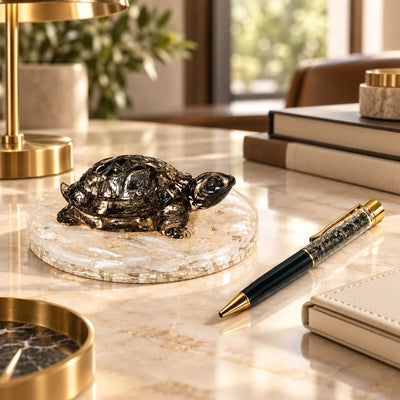
| Pyrite turtle on a selenite plate | Prosperity and business growth | No — keep completely dry | Desk, cash counter, entrance |
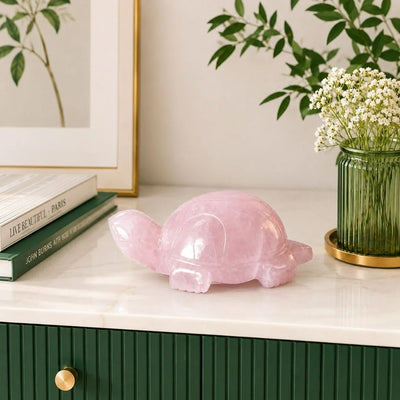
| Rose quartz (pink) turtle | Love, warmth and a peaceful home | Not needed; keep out of strong sun | Living room, or bedroom if your tradition allows |
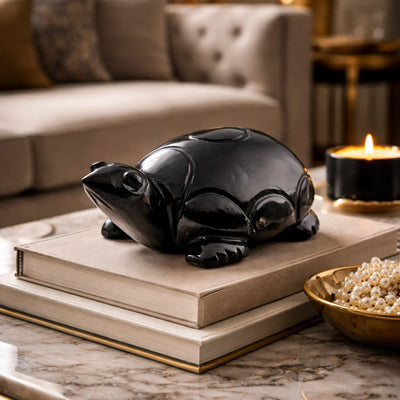
| Black onyx turtle | Composure and steadiness | No soaking | Executive desk, study, entrance |
| Glass or clear crystal tortoise | Steady progress; a common Vastu tortoise | Sometimes kept in water | North or north-east |
A quick way to choose: if your intention is work or business, a pyrite turtle is the most popular choice; for home and relationships, rose quartz; for a plain, formal desk, black onyx. Most solid black onyx is colour-treated chalcedony — a standard practice in the trade, and something an honest seller will tell you.
Should you keep a feng shui turtle in water?
This is where many people go wrong. The "turtle in a plate of water" practice is followed mainly with metal tortoises, and some people follow it with glass ones too. Even for metal, guides disagree — some advise against water because it can damage the finish or paint. And it does not suit every material:
- Pyrite: keep it dry. In damp conditions pyrite reacts with moisture and air; it tarnishes and, over time, can crumble.
- Selenite plate: keep it dry. Selenite is very soft (Mohs 2) and slightly water-soluble, so it loses its surface and can crumble if kept wet.
- Black onyx: avoid soaking, as water and acidic cleaners can affect the polish and colour treatment.
- Rose quartz: water will not harm it, but there is no need to keep it in water. Keep it out of long, direct sunlight — rose quartz from some sources can fade in strong light.
So if your turtle is pyrite, or sits on a selenite plate, the plate itself is its "base" — no water bowl is needed. Simply wipe it with a soft, dry cloth.
How to set up your turtle
- Clean it with a soft, dry cloth (a slightly damp cloth only for quartz, then dry it).
- Choose the spot — north, on a raised and dry surface, where you will see it daily.
- Set an intention — for example, "I will grow my work steadily and patiently."
- Keep it tidy — dust-free and away from clutter. A chipped or broken figure is traditionally replaced rather than kept.
Many people cleanse crystals with incense smoke or the sound of a bell. For pyrite and selenite, stick to these dry methods and avoid any water-based cleansing. Our guide to the selenite charging plate explains dry cleansing in more detail.
Feng shui turtle as a gift
Because it stands for long life and steady growth, a turtle is a popular gift for a housewarming, a new office or shop opening, a promotion, a retirement, or Diwali and Dhanteras. For a desk gift, the Shubh Labh Desk Set pairs the pyrite turtle with a pyrite pen, and the Shubh Labh Desk Set Premium adds an orgonite pyramid. For a home, a rose quartz turtle in its wooden box is a gentler choice.
Frequently Asked Questions
Which direction should a feng shui turtle face?
The most common advice is to keep it in the north. At the entrance, the usual Vastu convention is to keep its head facing into the home; guides differ on the exact compass direction.
Where should I keep a pyrite tortoise?
On an office desk, cash counter or entrance table, ideally in the north, on a dry raised surface. Never put a pyrite tortoise in water. For more on pyrite pieces, see where to keep pyrite stone at home.
Is a feng shui turtle good for wealth?
Many people keep a pyrite turtle near the cash counter as a feng shui turtle for wealth and prosperity. In Feng Shui the turtle is mainly known for support, protection and longevity. It is a traditional symbol, not a guarantee of money.
Can I keep a crystal turtle in the bedroom?
Traditions differ. Many people keep a rose quartz turtle on a bedside shelf, while some Vastu guides advise keeping tortoises out of the bedroom. Either way, never keep it on the floor or under the bed.
Can a tortoise be kept in water?
Some people keep metal or glass tortoises in a shallow plate of water, though guides disagree even on that. Pyrite and selenite must stay dry, and onyx should not be soaked.
What is the difference between a feng shui turtle and a vastu tortoise?
The figure is the same; the reasoning differs. Feng Shui links the turtle to the Black Tortoise of the north and to "support at your back", while Vastu treats the tortoise as a symbol of stability and steady growth, also usually placed in the north.
Is a feng shui turtle a good gift?
Yes — it is a common gift for housewarmings, new offices, promotions and Diwali, because it stands for long life and steady growth.
Read Next
- Where to Keep Pyrite Stone at Home
- Laughing Buddha Gift Guide
- Crystal Tree Benefits According to Vastu Shastra
- 7 Horses Painting Direction as per Vastu
Sources for the history and care notes: Drik Panchang – Lord Kurma; US National Park Service – pyrite decay and humidity; Gypsum (selenite) – hardness and solubility; GIA – rose quartz.
Feng Shui and Vastu meanings described here are traditional and cultural beliefs, not proven effects. They are not a substitute for financial, medical or professional advice.
Shop the products in this guide
Natural stones, free delivery and cash on delivery across India.