Quick Answer
Turquoise (Hindi: Firoza or Feroza) is an opaque blue to blue-green stone made of hydrated copper and aluminium phosphate. In crystal tradition, turquoise stone meaning centres on calm, honest communication, protection while travelling and emotional balance, and it is linked with the Throat Chakra (Vishuddha). It is one of the oldest gemstones in human use, worn in ancient Egypt, Persia and by Native American cultures.
It is also a soft, porous stone (Mohs 5–6) and one of the most imitated gems on the market. This guide covers what turquoise actually is, what the tradition says, turquoise bracelet benefits, and how to avoid buying dyed howlite.
What Is Turquoise Stone?
| Mineral | Hydrated copper aluminium phosphate, CuAl₆(PO₄)₄(OH)₈·4H₂O |
| Hindi / Persian name | Firoza (from Persian pīruzeh, "victory") |
| Colour | Sky blue to green; copper gives the blue, iron pushes it toward green |
| Hardness | About 5–6 on the Mohs scale |
| Structure | Opaque and porous — it absorbs oils, water and dyes |
| Main sources | Iran (Nishapur), USA (Arizona, Nevada), China, Egypt (Sinai) |
| Birthstone | December (Western tradition) |
| Rashi (Calminds zodiac guide) | Dhanu (Sagittarius) |
| Chakra (crystal tradition) | Throat (Vishuddha) |
The English name comes from the French pierre turquoise, "Turkish stone", because Persian turquoise reached Europe through Turkish trade routes.
The dark veins you often see are called matrix — the host rock the turquoise formed in. Matrix is natural and is not a defect. Persian (Irani) turquoise is traditionally prized for an even, clear sky blue with little or no matrix.
Turquoise Meaning and Traditional Benefits
The associations below come from crystal practice and cultural tradition. They are beliefs, not measured effects.
- Clear, calm communication — as a Throat Chakra stone, it is traditionally worn by people who speak for a living or struggle to say what they mean.
- Protection while travelling — Persian and Turkish riders tied turquoise to horses and wore it as an amulet against falls. It is still called the traveller's stone.
- Emotional balance — associated with a steady, unhurried mood.
- Friendship and goodwill — in many cultures turquoise is a gift stone, and some traditions say it is luckiest when received rather than bought.
Turquoise (Firoza) in Indian Practice
Firoza is not one of the nine Navaratna gems. In Indian practice it is often linked with Brihaspati (Jupiter) and with wisdom and clear speech, but sources differ, and some astrologers associate it with other planets. In our crystal guide for each zodiac sign, turquoise is the suggested crystal for Dhanu (Sagittarius), for calm and steadiness. If you are wearing Firoza as an astrological stone rather than as a crystal, ask an astrologer who has read your chart.
What Turquoise Will Not Do
Some websites claim turquoise cures throat infections, lowers fever or "absorbs" illness. There is no evidence for any of this. What a turquoise bracelet can reasonably do is act as a reminder — for example, to slow down before a difficult conversation. If you have health or anxiety concerns, please see a doctor.
Turquoise Bracelet Benefits for Women and Men
The traditional associations are the same for everyone. People tend to choose a turquoise stone bracelet for:
- Work that involves speaking — teachers, salespeople, presenters, anchors and lawyers
- Travel, following the traveller's-stone tradition
- Speaking up in meetings or family discussions
- A December birthday, as a birthstone gift
- Everyday colour — its blue-green suits both ethnic and western wear
How to Wear a Turquoise Bracelet
- Left wrist — the receiving side in crystal tradition, chosen for calm and balance.
- Right wrist — the projecting side, often chosen for speaking and presenting.
Neither is wrong. Many people put it on deliberately before a presentation or an interview and use that moment to set an intention.
Turquoise options at Calminds:
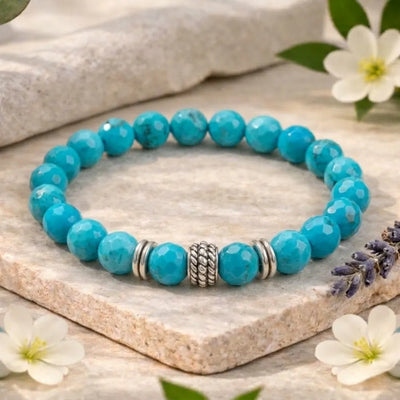
- Turquoise Crystal Bracelet (8mm, faceted) — everyday beaded bracelet with a gold-tone charm
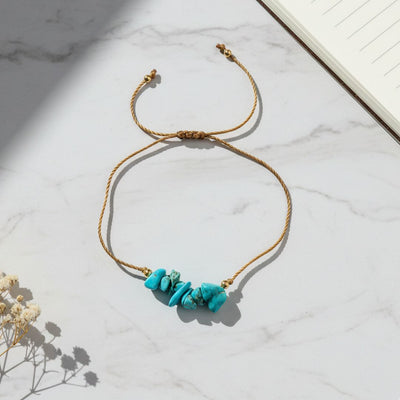
- Turquoise Thread Bracelet and Turquoise Beads Thread Bracelet — lightweight and adjustable
- Irani Turquoise Tumbles (set of 5) — to carry, hold during meditation or place on a desk
Every Calminds piece goes through our S.P.A.C.E. process (Sourced, Purified, Activated, Crafted, Examined) and is Reiki-charged by Sweeny Panjrath before dispatch.
Can You Wear Turquoise (Firoza) With Pyrite?
Yes. Crystal tradition has no rule against wearing turquoise and pyrite together, and some people pair them — turquoise for calm communication, pyrite for confidence and prosperity. Two practical points:
- Turquoise is not a money stone in tradition. If wealth is your intention, pyrite, citrine or green aventurine are the traditional choices — see best crystals for money.
- Protect the turquoise from prolonged moisture and cosmetics. Pyrite and turquoise have different care needs, so follow the care guidance for each stone.
For which wrist to wear pyrite on, read which hand to wear a pyrite bracelet. If you follow astrology closely and are combining stones for planetary reasons, ask your astrologer.
Is African Turquoise Real Turquoise?
No. "African turquoise" is a trade name for a blue-green jasper, not turquoise. It is a natural stone with its own traditional meaning, but it is a different material. The same goes for "turquenite" and "howlite turquoise", which are usually dyed howlite. If a bracelet lists African turquoise, it is not Firoza.
How to Tell If Turquoise Is Real
The most common fake turquoise is howlite or magnesite dyed blue; others are plastic, glass and "reconstituted" turquoise (powder bound with resin).
- Look closely at the matrix, but do not rely on appearance alone. Dye may collect in fractures or pores in imitations, while natural turquoise can also show varied matrix patterns. This is only a clue, not proof of identity.
- Compare the beads. Natural turquoise can vary in colour and matrix, but uniformity alone cannot prove that a piece is imitation.
- Inspect drill holes only as one clue. A contrasting core or colour concentration may indicate dye or a surface treatment, but it is not a conclusive test.
- Do not use touch as proof. Weight and temperature can help raise questions about plastic imitations, but they cannot authenticate turquoise.
- Ask what treatment it has. Genuine turquoise may be stabilised with wax, resin or polymer to improve durability or appearance. Ask the seller to disclose stabilisation, dyeing or other treatments; visual checks cannot confirm them reliably.
For a wider walkthrough, see our real vs fake crystals guide.
How to Care for Turquoise
Because turquoise is porous, care matters more for it than for most stones.
- Avoid soaking and prolonged moisture. Remove turquoise jewellery before bathing or swimming. For cleaning, GIA says warm, soapy water is acceptable; use it briefly, rinse gently and dry with a soft cloth. Avoid steam and ultrasonic cleaners.
- Keep it away from cosmetics, perfume, lotion and hair oil. Chemicals and skin oils can discolour turquoise over time.
- Avoid long sun and heat. Strong heat can dry it out and fade the colour.
- Clean gently. A soft cloth is suitable for routine wiping; if needed, use brief warm, soapy water and dry thoroughly. Never use steam or ultrasonic cleaners, and avoid solvents or harsh chemicals.
- Cleanse traditionally with moonlight, incense smoke or a selenite plate, not water or salt. See how to cleanse crystals safely.
A slow change of colour with years of wear is natural and is often valued as a patina.
Crystals That Pair Well With Turquoise
- Lapis Lazuli — another Throat Chakra stone, associated with truth and wisdom
- Amazonite — traditionally used for confidence in speaking
- Blue Apatite — associated with clear expression
- Clear Quartz — traditionally used to amplify intention
Frequently Asked Questions
What is turquoise stone called in Hindi?
Firoza (also spelled Feroza), from the Persian word for victory.
What is the meaning of turquoise stone?
In crystal tradition turquoise stands for calm communication, protection while travelling and emotional balance. These are traditional beliefs, not proven effects.
What are the benefits of a turquoise bracelet?
People wear a turquoise bracelet as a reminder to speak calmly and clearly, as a traveller's stone and as a birthstone. These are traditional associations.
Which rashi should wear turquoise?
In our zodiac guide, turquoise is suggested for Dhanu (Sagittarius). Anyone can wear it as a crystal; for astrological use, ask an astrologer.
Is turquoise good for money?
Turquoise is not traditionally a wealth stone. Pyrite, citrine and green aventurine are the usual choices for money and prosperity intentions.
Can turquoise go in water?
Do not soak turquoise or leave it in water. GIA says turquoise jewellery can be cleaned with warm, soapy water, then gently rinsed and dried. Avoid steam and ultrasonic cleaners; remove bracelets before bathing or swimming.
Why did my turquoise turn green?
Turquoise absorbs skin oils, perfume and lotion, which can shift the colour toward green over time. Keeping it away from cosmetics slows this.
How can I tell if turquoise is real or fake?
Look for possible clues such as colour collecting in pores or drill holes, unusual uniformity, or a contrasting core, but none of these proves that a stone is fake. Natural turquoise also varies, and treatments can be difficult to identify visually. Ask the seller to disclose whether the stone is stabilised, dyed or reconstituted; use a qualified gemmologist for reliable identification.
Is Irani (Persian) turquoise better?
Persian turquoise from Nishapur is historically the most famous, valued for its even sky-blue colour. Quality, colour and treatment still matter more than origin alone.
Sources and Further Reading
For gemmological information on turquoise hardness, cleaning and stability, see the GIA Turquoise Care and Cleaning Guide. For information on dyeing and stabilisation, see the International Gem Society guide to gemstone treatments. Traditional and spiritual associations are drawn from cultural history and crystal practice and are presented as beliefs, not measured effects.
Disclaimer: Crystal meanings described here are based on traditional beliefs and spiritual practices. They are not a substitute for medical, financial, or professional advice.
Shop the products in this guide
Natural stones, free delivery and cash on delivery across India.