Quick Answer
Black obsidian is natural volcanic glass, formed when silica-rich lava cools so quickly that crystals do not have time to grow. In crystal tradition, black obsidian meaning centres on protection, grounding and honest self-reflection — it is often called a "mirror stone" — and it is linked with the Root Chakra and, in our zodiac guide, with Vrishchik (Scorpio).
Because it is glass, obsidian is softer than quartz (about Mohs 5–5.5) and can break with sharp, curved edges. Handle chipped pieces carefully.
What Is Black Obsidian Stone?
| Type | Natural volcanic glass (a mineraloid, not a crystal) |
| Composition | Mostly silicon dioxide (roughly 70% or more), with iron and magnesium giving the dark colour |
| Hardness | About 5–5.5 on the Mohs scale |
| Fracture | Conchoidal — smooth, shell-shaped breaks with razor-sharp edges |
| Lustre | Glassy (vitreous) |
| Main sources | Mexico, USA, Armenia, Turkey, Iceland, Japan and other volcanic regions |
| In Hindi | Usually just called obsidian; descriptively jwalamukhi kaanch (volcanic glass) |
| Rashi (Calminds zodiac guide) | Vrishchik (Scorpio) |
| Chakra (crystal tradition) | Root (Muladhara) |
Strictly speaking, obsidian is not a crystal because it has no ordered internal structure. In everyday crystal practice it is still grouped with crystals and healing stones, so you will see it sold as "obsidian crystal".
Types of Obsidian
| Type | What you see | What causes it |
|---|---|---|
| Black obsidian | Solid, glossy black | Fine iron and magnetite particles |
| Snowflake obsidian | White or grey "snowflakes" on black | Clusters of cristobalite that crystallised inside the glass |
| Rainbow obsidian | Bands of colour visible under light | Tiny aligned mineral inclusions |
| Gold / silver sheen | A metallic shimmer | Gas bubbles aligned during lava flow |
| Mahogany obsidian | Red-brown patches on black | Iron oxide (hematite) inclusions |
| Apache tears | Small rounded pebbles, translucent against light | Weathered nodules of obsidian |
A buyer warning: vivid blue, green or transparent reddish obsidian is uncommon, and manufactured glass imitations are also sold under these names. Colour alone cannot confirm whether a piece is natural; ask for reliable provenance or gemmological testing.
Black Obsidian Meaning and Traditional Associations
Black obsidian is volcanic glass, not a quartz-family mineral. Its polished, reflective surface and sharp conchoidal fracture give it a different history and character from black onyx. The associations below come from cultural history and crystal practice; they are beliefs, not measured effects.
- Self-reflection — polished obsidian was historically used as a mirror in parts of Mesoamerica. In modern crystal practice, this history is often connected with honest self-examination.
- Recognising patterns — some people use it as a symbolic prompt to notice habits or reactions they want to change.
- Transition and letting go — traditionally selected during periods of change, such as the end of a routine or the start of a new chapter.
- Protection as a cultural symbol — some traditions keep obsidian as a protective object; this is a symbolic belief, not a physical shield or a way to absorb energy.
Unlike black onyx, obsidian is glass formed when silica-rich lava cools quickly. It can chip or fracture, so its practical care and durability are different from chalcedony jewellery.
There is no reliable evidence that obsidian detoxifies the body, removes negative energy as a physical process or treats pain. It can be used as a personal object for reflection, not as a health treatment.
Black Obsidian vs Black Tourmaline vs Black Onyx
| Black Obsidian | Black Tourmaline | Black Onyx | |
|---|---|---|---|
| What it is | Volcanic glass | Boron silicate mineral | Chalcedony (quartz family) |
| Hardness | 5–5.5 | 7–7.5 | 6.5–7 |
| Look | Very glassy, sharp curved breaks | Often striated, matte to glassy | Smooth, even black; usually dyed |
| Traditional focus | Self-reflection, letting go | Protection, shielding | Discipline, inner strength |
More in our guides to black onyx and black tourmaline.
Black Obsidian Bracelet Benefits and Which Hand to Wear
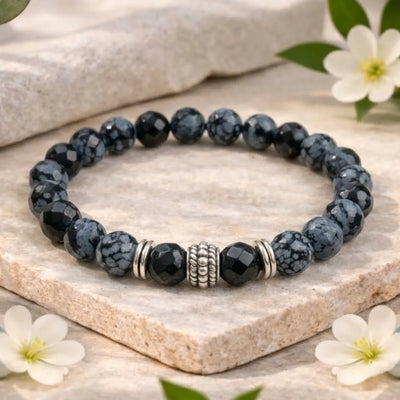
People wear an obsidian bracelet as a daily reminder of grounding and protection, and many choose it during a period of change. The Snowflake Obsidian Bracelet (8mm, diamond-cut) is a softer, more reflective version of black obsidian.
- Left wrist — the receiving side in crystal tradition, the more common choice for obsidian's protective and reflective associations.
- Right wrist — the projecting side; people who wear black obsidian on the right hand usually do so for action and letting go.
There is no strict rule.
Black Obsidian Crystal Tree: Meaning and Where to Keep It
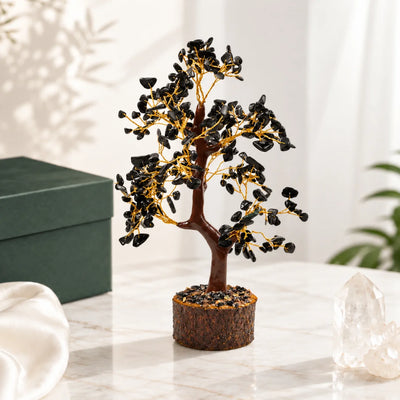
The Black Obsidian Crystal Tree is made with obsidian chips on golden wire branches and a wooden base. In Vastu-inspired practice:
- Main entrance — the most common placement for protection, as in our guide to crystal trees for Vastu
- South-West of the bedroom — traditionally for release and past patterns, as in our Vrishchik rashi stone guide
- Near a desk or electronics — a common modern placement
These are traditional placements, not rules. Choose the spot where you will actually see it and pause.
Can You Wear Black Obsidian With Other Stones?
- Pyrite and black obsidian — a common pairing for confidence with protection. For which wrist to wear pyrite on, read which hand to wear a pyrite bracelet.
- Clear or milky quartz and black obsidian — traditionally read as clarity alongside grounding.
- Black tourmaline and obsidian — a stronger protective combination.
- Red jasper and obsidian — protection with grounding, as listed in our zodiac crystal guide.
How to Tell If Obsidian Is Real
- Consider the colour, but do not use it as a verdict. Black, grey and brown are familiar colours; blue, green and transparent reddish varieties are rare but documented. Manufactured glass imitations also exist.
- Look for natural features. Flow banding, crystallites, mineral inclusions and sheen can be useful clues. A uniform appearance by itself does not prove that a piece is artificial.
- Understand bubbles correctly. Natural obsidian can contain gas bubbles, including elongated or rounded cavities; some natural specimens are notably vesicular. Bubbles alone do not prove that a piece is manufactured glass.
- Hold thin edges to a torch. Thin edges of black obsidian often let a little smoky light through.
- Price and source. Ask where it comes from; a seller who knows the stone will be able to tell you.
See also our real vs fake crystals guide.
How to Care for Obsidian
- Handle broken pieces carefully — chipped obsidian can have very sharp edges.
- Avoid knocks. It is glass, so a drop on a hard floor can chip or shatter it.
- Store separately from harder stones like quartz and tourmaline, which will scratch it.
- Cleaning: wipe with a soft, slightly damp cloth. Avoid long soaking, which can dull the surface over time, and keep a strung bracelet out of water, because the elastic weakens.
- Traditional cleansing: moonlight, incense smoke or a selenite plate. See how to cleanse crystals safely.
Every Calminds piece goes through our S.P.A.C.E. process (Sourced, Purified, Activated, Crafted, Examined) and is Reiki-charged by Sweeny Panjrath before dispatch.
Frequently Asked Questions
What is the meaning of black obsidian?
In crystal tradition black obsidian stands for protection, grounding and honest self-reflection. These are traditional beliefs, not proven effects.
What are the benefits of black obsidian?
People keep it as a reminder of grounding and protection, and use it in reflection or meditation, especially during change. These are traditional associations.
Does black obsidian absorb negative energy?
That is the traditional belief, and it is why obsidian is kept at entrances and cleansed often. There is no scientific evidence that any stone absorbs energy; treat it as a symbolic practice.
Is obsidian a crystal?
No. It is natural volcanic glass with no crystal structure. It is still commonly grouped with healing crystals.
What is black obsidian called in Hindi?
It is usually just called obsidian. Descriptively it is jwalamukhi kaanch, meaning volcanic glass.
Which rashi should wear black obsidian?
In our zodiac guide, obsidian is suggested for Vrishchik (Scorpio). Anyone can wear it as a crystal.
What is the difference between black and snowflake obsidian?
Both are volcanic glass. Snowflake obsidian contains white clusters of cristobalite that formed inside the glass as it cooled.
Can obsidian go in water?
A loose stone can take a brief rinse; avoid long soaking. Keep an obsidian bracelet out of water, because the elastic weakens.
Where should I keep black obsidian at home?
Traditionally near the main entrance for protection, or in the South-West of the bedroom for release. These are traditional placements, not rules.
Is blue or green obsidian real?
Almost never. Brightly coloured "obsidian" is usually man-made glass. Natural obsidian is black, grey, brown or sheened.
Why did my obsidian break?
Obsidian is glass and breaks on impact. For what the tradition says about broken stones, read why did my crystal break?
Sources and Further Reading
For the formation of obsidian and its volcanic-glass properties, see the American Museum of Natural History's Obsidian Guide. Natural gas bubbles in obsidian are documented by Oregon State University's Volcano World and by GIA's 2025 report on bubble obsidian. Traditional associations are presented as beliefs, not scientific effects.
Disclaimer: Crystal meanings described here are based on traditional beliefs and spiritual practices. They are not a substitute for medical, financial, or professional advice.
Shop the products in this guide
Natural stones, free delivery and cash on delivery across India.