
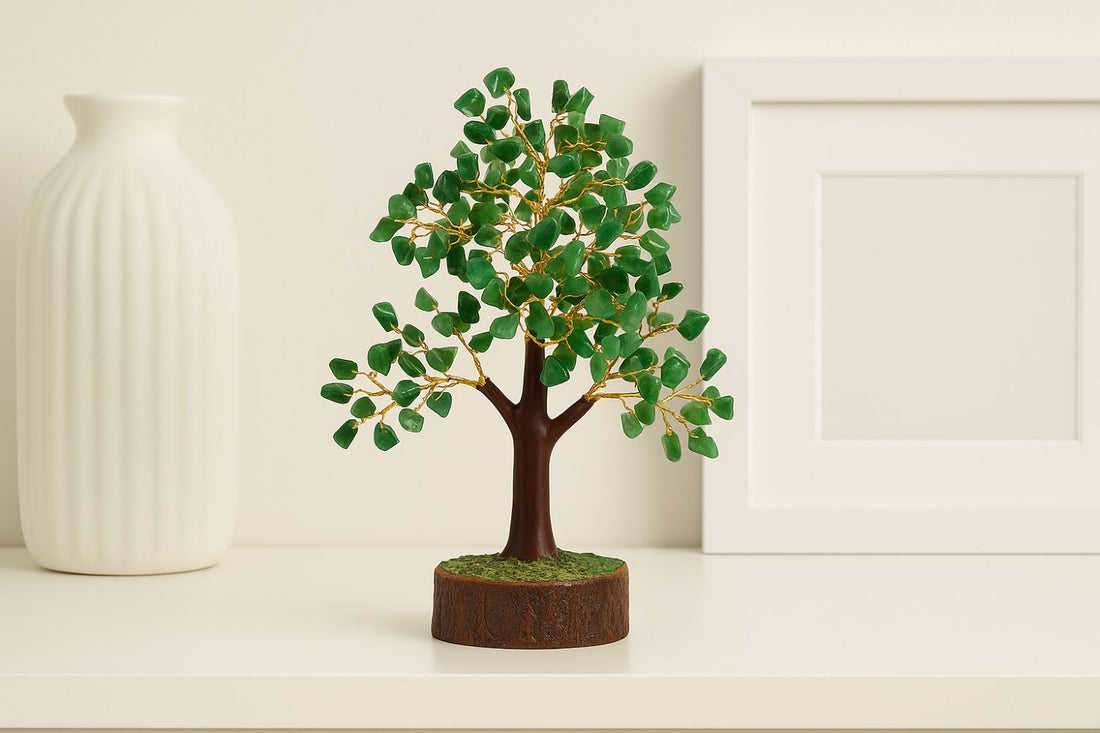
Quick answer: Home décor cannot guarantee luck, but in crystal tradition a green aventurine tree is kept as a reminder of opportunity, growth and new beginnings. It is usually placed at the entrance or on a desk or shop counter, with Feng Shui favouring the southeast and Vastu the north or east. Real aventurine is quartz that shimmers from fuchsite mica inside. These are traditional meanings, not proven effects.
Green aventurine is the stone people buy when the intention is luck and growth — a new job, a new business, a fresh start. That gives its tree a fairly specific job in a home, and a fairly specific place: the entrance or the workspace, where the day begins. This guide covers the stone itself, how to tell real aventurine from the dyed and glass imitations, and where a green aventurine tree actually belongs.
What Is a Green Aventurine Crystal Tree?
The Green Aventurine Crystal Tree is a hand-wired piece made with natural green aventurine chips on bendable golden branches, set in a solid wooden base. It stands 25 cm tall and weighs about 400 grams — substantial enough to hold its place on an entryway table or a desk without being knocked over, which matters for the placements this stone suits.
What green aventurine actually is: the mineralogy
Green aventurine is quartz — silicon dioxide, the same base mineral as clear quartz, rose quartz and amethyst — which puts it at 7 on the Mohs hardness scale. It is a hard, hard-wearing stone, and that is part of why it holds up as a tree.
What makes it green, and what makes it distinctive, is fuchsite: a chromium-bearing green mica that occurs as tiny platelets scattered through the quartz. Those platelets are the colour, and they are also the reason aventurine glitters.
Aventurescence — the shimmer, and the authenticity test
The effect has a name: aventurescence. Tilt a piece of real green aventurine under a light and you see a soft, moving sparkle from within the stone — not a surface gloss, but flashes coming off the mica flakes suspended inside it as the angle changes. The stone is named for the effect, and the effect is the whole character of the material.
It is also the single most reliable way to check what you are buying, because the two common substitutes cannot fake it:
- Dyed green quartz looks flat. The colour sits evenly through the stone with no internal sparkle, and often pools along cracks where the dye has crept in. No shimmer, no aventurine.
- Green glass looks flat and too perfect. Uniform colour, glassy transparency, and frequently tiny round bubbles — which natural stone never has. It may shine on the surface but there is nothing glittering inside it.
- Real green aventurine is slightly variable chip to chip — some deeper, some paler, some cloudier — and under a lamp the branches flicker with pinpricks of light as you turn the tree.
Test a tree this way in the first minute you have it: pick it up, turn it slowly beside a lamp, and look for the sparkle moving inside the chips rather than across them.
The Stone of Opportunity: luck and growth
Green aventurine is traditionally called the "Stone of Opportunity", and every association attached to it points the same way — forward.
1. Luck and prosperity
This is the association it is best known for and the reason most people buy it. In crystal tradition it is the stone kept close when something is being started or risked — a new job, a launch, an exam, a move — and it is the usual green-stone choice for a money or abundance placement.
2. Growth and new beginnings
The fresh-start stone. Career changes, new ventures, new chapters. Paired with the tree form — roots, trunk, branches, something that visibly grows — the symbolism is unusually well matched here; more so than for any other stone in the range.
3. Green, and the heart chakra
Being green, aventurine is linked in crystal tradition to the heart chakra, the centre associated with compassion and balance. That is where its gentler reputation comes from, and why it is often given to someone going through a transition rather than only to someone chasing a win.
4. Intention and focus
A practical use rather than a mystical one: kept beside a vision board, a business plan or a goal list, the tree acts as the physical marker for that intention — a reminder that sits in the room whether or not you are thinking about it.
Where to Place a Green Aventurine Crystal Tree
Placement is a matter of tradition and intention rather than a fixed rule, but for a luck-and-growth stone two spots do most of the work.
The entrance
The entryway is the traditional first choice for an opportunity stone, on the simple logic that it is the threshold — the point where everything that comes into the home comes in. A console or shoe-rack top beside the door, at roughly waist height, where it is the first thing seen on the way in and the last on the way out. Keep it out of the door's swing and clear of where keys and bags get dumped; a tree buried under post stops being a marker of anything.
The office or workspace
The second natural home, because this is the stone of work and opportunity and that is where the work happens. On a desk, put it at the back corner on the side you turn to when you look up — not behind the monitor, where it vanishes. In a shop or a small business, the counter or the till area is the traditional spot for the same reason the entrance is: it is where the exchange happens. A 400 g wooden base is heavy enough for a counter, which a lighter tree is not.
Feng Shui and Vastu
- Feng Shui: the southeast corner of a home, room or desk is the sector traditionally linked to wealth intent, which is where money and abundance pieces are usually placed.
- Vastu: the north and east sides of a room are the directions commonly favoured for prosperity and new beginnings, so an east-facing shelf or a north wall is a sensible spot.
- Keep it visible. A crystal tree is meant to be seen. Left in a cupboard or a drawer it stops acting as the daily reminder of your intention that it is there to be — give it a place on a desk, shelf, entryway table or pooja space where it catches your eye.
- Practical notes: keep it out of damp rooms and away from the edge of busy surfaces, and out of long hours of direct sun, which dulls the wooden base and the wire finish.
For the full room-by-room method — including how to locate the sectors in your own floor plan — see our crystal tree placement guide.
How to Take Care of Your Crystal Tree
-
Never wash or soak the tree. Water works into the wire wraps and the adhesive in the base and loosens them over time, so chips shed and the trunk goes loose. Dust it gently and dry, with a soft cloth or a soft brush, working outwards from the trunk. An entryway tree collects more dust than most, so expect to do this more often.
-
Recharge under moonlight or near plants for a few hours, if that is part of your practice.
-
Avoid damp areas to protect the wooden base and the wiring.
Is It Real, and Is It Worth It?
Start with the shimmer test above — it settles the question faster than any certificate. Beyond that, each Calminds crystal tree goes through the S.P.A.C.E. process:
-
Sourced from trusted and ethical mines.
-
Purified with sage and light.
-
Activated with Reiki.
-
Crafted with care and purpose.
-
Examined for quality and authenticity.
You can see the current price and any live offer on the product page, or browse the whole range in our crystal trees collection.
Gifting a green aventurine tree
This is the tree to give when someone is starting something: a new job, a new business, a shop opening, a move to a new city, a first office. The opportunity association makes the gesture legible even to a recipient with no interest in crystals — it reads as "good luck with it", in object form.
Is green aventurine the right stone for you?
Green aventurine is the luck-and-growth choice. If your intention is relationships, rest or clear-headed work rather than opportunity, a different stone fits better — our guide to choosing the right crystal tree compares them stone by stone.
So, Can Home Décor Really Bring Luck?
What a green aventurine tree genuinely does is put an intention somewhere you cannot miss it — at the door you walk through every morning, or the desk where the work gets done — in a material with real character: quartz shot through with fuchsite mica, glittering when the light moves across it. Check for that shimmer, give it the entrance or the workspace, keep it visible, and dust it dry.
Shop the products in this guide
Natural stones, free delivery and cash on delivery across India.
Frequently Asked Questions
Where should a green aventurine tree be placed?
The east is the direction Vastu associates with growth and new beginnings, and the south-east with wealth intent. A study desk, office table or living room shelf are the usual spots. These are traditional associations rather than tested placements.
What is green aventurine actually made of?
It is quartz with inclusions of fuchsite, a green chromium-bearing mica. Those tiny platelets are what give it the faint glitter, called aventurescence. It sits at Mohs 7, so it is durable.
Does a green aventurine tree bring luck?
Green aventurine is traditionally called the Stone of Opportunity and is associated with luck and new beginnings in crystal practice. There is no evidence that an object creates luck. What people find useful is the daily reminder of a goal they have set.
How do you care for a green aventurine tree?
Dust it dry, with a soft brush between the branches and a dry cloth on the base. Never rinse or soak it: the chips are held by wrapped wire and the trunk is set with adhesive, and water loosens both.
How can you tell a real green aventurine tree from a fake?
Real chips vary in tone from pale sage to deeper green, and show a faint internal glitter in sunlight rather than a surface sparkle. A perfectly uniform bright green with glassy clarity and no variation usually means dyed quartz or glass.
Is a green aventurine tree a good gift?
It is a common choice for new homes, new jobs and business openings, precisely because its traditional association is with fresh starts and opportunity.


