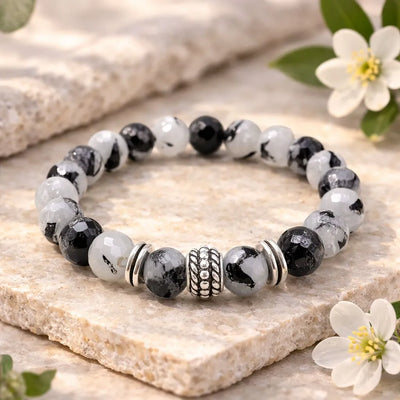
Quick answer: You can identify real black rutile quartz mainly by its inclusions: genuine stones show random, irregular black needles that differ from bead to bead, while fakes look uniform or patterned. Real quartz also feels cool at first, shows no round air bubbles under magnification and feels solid for its size. An unusually low price often points to glass, dyed quartz or synthetic material.
You may have already learned about the benefits and meaning of Black Rutile Quartz, and you might also know which hand to wear a Black Rutile Quartz bracelet on for the best results.
But there is one critical truth many people overlook:
If your Black Rutile Quartz is fake, none of its grounding or protective benefits truly work.
Today, the crystal market is flooded with glass, resin, and dyed stones sold as “natural crystals.” These imitations may look attractive, but they do not carry the natural structure or properties traditionally associated with genuine Black Rutile Quartz.
At Calminds, authenticity comes first. This guide will help you clearly understand how to identify real vs fake Black Rutile Quartz, so you can buy with confidence and avoid wasting money on imitation stones.
Why Authenticity Matters in Black Rutile Quartz
Crystals are valued not only for their appearance but for their natural formation inside the Earth.
Real Black Rutile Quartz forms when rutile mineral inclusions develop naturally within clear quartz over millions of years. This slow natural process creates the grounding and stabilizing properties that people seek.
Imitation stones, on the other hand, are manufactured quickly using glass or plastic. While they may look shiny, they lack the natural internal structure found in genuine quartz.
If your goal is emotional grounding, clarity, or protection from negativity, authenticity truly matters.
Test 1: The Visual “Chaos” Test (Most Reliable)

The easiest and most accurate way to identify real Black Rutile Quartz is by carefully observing the black needle-like inclusions inside the stone.
Real Black Rutile Quartz
- Inclusions look random, irregular, and chaotic
- Needles vary in thickness and direction
- Patterns differ from bead to bead
- No two stones look exactly alike
Fake Stones
- Lines appear too straight, uniform, or repeated
- Every bead looks almost identical
- Patterns look designed rather than naturally formed
Remember: Nature is never perfectly symmetrical.
Small irregularities are actually a strong sign of authenticity.
Test 2: The Temperature Test (Touch Method)
Hold the bracelet or a single bead in your hand.
- Real quartz feels cool at first and warms up slowly
- Glass or plastic usually feels room-temperature or warms instantly
You can also gently touch the stone to your cheek. If it feels naturally cool and soothing, it is more likely genuine quartz.
Test 3: The Bubble Test (Glass Detection)

This test is very effective for spotting glass imitations.
Examine the clear areas of the stone using:
- A magnifying glass, or
- Your phone camera with zoom
Fake Glass Stones
- Tiny round air bubbles trapped inside
- Smooth, overly perfect internal appearance
Real Black Rutile Quartz
- May show natural fractures or cloudy areas
- Never contains perfectly round air bubbles
Air bubbles are a strong indicator of glass manufacturing.
Test 4: Weight & Density Check
Authentic Black Rutile Quartz has noticeable density.
- Real quartz feels solid and slightly heavy for its size
- Fake stones often feel unusually light or hollow
If a bracelet feels toy-like or extremely lightweight, it’s wise to question its authenticity.
Test 5: The Price Reality Check
Black Rutile Quartz is not a mass-produced stone.
If you see a bracelet priced extremely low, it usually indicates:
- Glass beads
- Dyed quartz
- Synthetic materials
Authentic Black Rutile Quartz costs more due to:
- Natural rarity
- Mining and cutting process
- Hand selection and quality checks
If a price seems too good to be true, it usually is.
Common Myths About Fake Crystals
Myth: “If it looks good, it must be real.”
Truth: Many fake stones are designed to look visually perfect.
Myth: “Energy depends only on belief.”
Truth: Belief matters, but natural structure also plays a role in traditional crystal practices.
Myth: “All online crystals are fake.”
Truth: Authenticity depends on the seller’s transparency and quality control.
How to Buy an Authentic Black Rutile Quartz Bracelet Online

Before purchasing, always check:
- Real product photos (not stock images)
- Clear mention of “natural” or “untreated”
- Educational content from the brand
- Transparency and trust signals
At Calminds, every Original Black Rutile Quartz Healing Bracelet is:
- 100% natural and untreated
- Hand-selected for visible natural inclusions
- Carefully inspected for authenticity
- Energetically cleansed before shipping
After Buying: Correct Use Matters Too
Once you own an authentic stone, wearing it correctly helps you experience its full benefits.
Many people are unsure whether they should wear their bracelet on the left or right hand. The correct choice depends on whether you want healing or protection.
To understand this clearly, read our detailed guide on which hand to wear a Black Rutile Quartz bracelet, based on your intention.
Why Calminds Focuses on Authenticity
We understand that buying crystals online requires trust.
That’s why at Calminds:
- Each bracelet is checked bead by bead
- Artificial treatments are avoided
- Natural patterns are preserved, not altered
When you choose an authentic stone, you choose long-term value, not just appearance.
Final Thoughts: Real Stone, Real Experience
The true value of Black Rutile Quartz lies in its natural formation and unique internal structure.
Imitation stones may look similar, but they cannot replace the grounding presence of genuine quartz.
✨ Ready to experience authentic energy?
Explore our Black Rutile Quartz Healing Bracelet, carefully selected for purity and natural balance.
Frequently Asked Questions (FAQs)
How can I tell if my Black Rutile Quartz is real?
Look for natural, irregular inclusions, absence of air bubbles, cool touch, and reasonable pricing.
Are fake Black Rutile Quartz bracelets common?
Yes. Glass and dyed stones are commonly sold at very low prices.
Does authenticity affect results?
In crystal traditions, natural formation is considered important for grounding and balance.
Can beginners identify real stones easily?
Yes. Using the visual and bubble tests alone can filter out most fake stones.
Shop the products in this guide
Natural stones, free delivery and cash on delivery across India.