

Quick answer: A rose quartz crystal tree is a popular gift for housewarmings, weddings, anniversaries and birthdays, because in crystal tradition rose quartz is the stone of love. The stone is pink quartz, 7 on the Mohs scale, and it fades in prolonged direct sunlight, so place the tree on a bedside table or shelf rather than a sunny windowsill.
A rose quartz crystal tree is the piece people reach for when they want something for the relationship corner of a home — or something to hand over at a housewarming, a wedding or a mother's birthday. This guide is about that: which tree suits which occasion, what to check before you buy one, and the sizes and bases that actually work on a bedside table or a gift shelf.
What rose quartz is — the short version
In crystal tradition rose quartz is the stone of love, linked to the heart chakra and to gentle, self-directed affection — which is exactly why it is the default gifting stone. We have written that story out properly, with the mineral history, the folklore and a nine-question FAQ, in Why Rose Quartz Is Called the 'Stone of Love' — start there if the meaning is what you came for, and come back here for the tree itself.
What the stone actually is: rose quartz mineralogy
Rose quartz is quartz — silicon dioxide, SiO2 — the same mineral as clear quartz and amethyst. It sits at 7 on the Mohs hardness scale, which is hard enough that ordinary household dust will not scratch the chips on your tree.
The pink does not come from the quartz itself. It comes from microscopic mineral inclusions — fine fibres of a borosilicate mineral dispersed through the stone — which is also why most rose quartz is cloudy and milky rather than glass-clear. Even colour with a soft, hazy body is normal and desirable; perfectly transparent hot-pink "rose quartz" at a low price is usually glass or dyed.
The fading problem — and why it changes where this tree goes
Rose quartz fades in prolonged direct sunlight. Weeks of afternoon sun on a bright windowsill will pull the pink towards a washed-out grey-white, and the colour does not come back. This is specific to rose quartz and it is the single most useful placement fact on this page: a sunny windowsill is the wrong place for a rose quartz tree. Pick a bedside table, a shelf set back from the window, a mantel, or an interior console — somewhere it gets daylight but not hours of direct sun.
Where to put it — the one-line version
In Feng Shui the southwest sector of a home or room is the one traditionally linked to relationships and partnership, so that is where a rose quartz tree is usually set; bedrooms and living rooms are the common everyday choices. For the full room-by-room method, including how to find the corner in your own floor plan, read our crystal tree placement guide.
Rose quartz trees as gifts: which occasion suits which tree
This is what a rose quartz tree is genuinely best at. It reads as a considered present even to someone who has no interest in crystals at all — it looks like sculpture, it needs no explanation, and it costs less than most decorative gifts of the same visual weight.
Housewarming
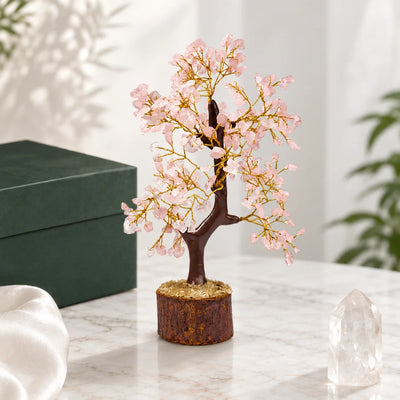
The safest crystal gift there is, because it does not assume anything about the recipient's beliefs or relationship status. A medium tree on a wooden base suits a new console table or a living-room shelf. If you know the home, a piece that matches the wood tones already in the room lands better than one that stands out.
Weddings and engagements
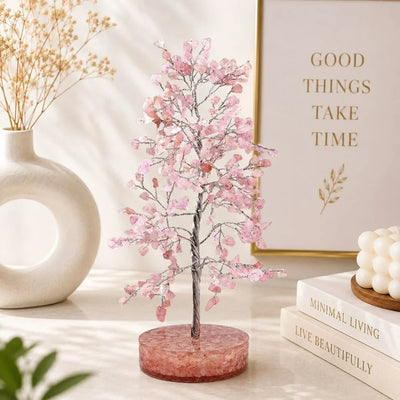
The relationship association makes this an easy fit, and it is one of the few wedding gifts that is not a duplicate of five other wedding gifts. Go slightly larger here — a wedding present should have presence. An orgonite base is the more striking choice for a couple who like a bit of drama in their décor.
Anniversaries
A pairing works well: a tree for the shelf alongside a rose quartz piece that can be worn, from our bracelets collection. The tree stays in the home, the bracelet travels — the two together read as more thought than either alone.
Mother's Day and birthdays
Smaller trees work best here, because they have to fit into a room that is already fully decorated. A 15–20 cm tree on a dressing table or bedside is far more likely to actually be used than a 30 cm piece that has nowhere to live.
For someone marking a difficult passage
A break-up, a bereavement, a move away from home. Rose quartz is the traditional choice for this and the gesture reads as warmth rather than advice. Say nothing about what it is supposed to do — hand it over as a beautiful object and let it be one.
Who a rose quartz tree suits
- People furnishing a first home who want one piece with meaning rather than a shelf of ornaments.
- Anyone buying for a recipient whose taste they do not know well — pink quartz on a wooden base is close to universally acceptable.
- Couples setting up a shared bedroom, where the relationship association is the point.
- People who already keep rose quartz and want a display piece rather than something to carry.
- Gift-givers on a fixed budget who want the object to look like it cost more than it did.
What to look for when buying a rose quartz tree
- Colour that is soft, not shocking. Real rose quartz is pale to medium pink and slightly cloudy. Vivid, uniform, glassy pink is a warning sign for dyed quartz or glass.
- Variation between chips. Natural stone is inconsistent — some chips paler, some with faint white veils. Chips that are all identical usually came out of a dye bath.
- Chip count and branch density. A full-looking tree needs a lot of stone. Thin, gappy branches are the main reason a cheap tree looks cheap in person.
- How the wire meets the base. The trunk should sit tight and straight in the base with no visible glue pooling or wobble. This joint is what fails first on a poorly made tree.
- Weight in the base. A light base tips. Anything going on a desk or a shelf where it may be knocked needs a base heavy enough to stay put.
- Bendable branches. Good wire branches can be shaped and re-shaped; brittle wire cracks its coating the first time you adjust it.
Sizes and bases: what to buy for which spot
Sizes
- Around 15 cm. Bedside table, dressing table, office desk with other things on it. The size to buy when you are not sure the recipient has room.
- Around 20–25 cm. The standard shelf and console size, and the safest all-purpose gift. Reads as substantial without dominating.
- 30 cm and up. Statement placement — an entryway table, a mantel, a wide empty shelf. Needs clear space around it or it looks crowded rather than impressive.
Wooden base vs orgonite base
A wooden base is the quieter option. It sits well in rooms with wood furniture, reads as natural décor rather than as a crystal object, and is the better choice for a recipient whose taste you are guessing at. It is also lighter, so it wants a spot where it will not be jostled.
An orgonite base is a cast resin base with metal and stone set into it. It is heavier, so it stands more securely, and it is visually far more striking — the base becomes part of the piece rather than just a stand. Choose it for someone who already collects crystals and will appreciate what the base is, or when you want the gift to have obvious impact.
Rose quartz trees at Calminds
- Rose Quartz Crystal Tree — wooden base
- Rose Quartz Crystal Tree with Orgonite Base
- Browse all crystal trees
Prices move with size, chip count and base type, so check the current figure on the product pages rather than relying on a number in an article.
Caring for a rose quartz tree
A wire-and-glue tree must never be washed or soaked. Water works into the wire wraps and into the adhesive in the base and loosens both — chips start shedding and the trunk goes soft in its socket. Dust it dry, with a soft brush or a dry cloth, working from the trunk outwards. Keep it out of damp rooms, and — as above — off sunny windowsills, which fade the pink.
Still deciding which stone?
If you are choosing between rose quartz, amethyst, clear quartz and green aventurine for a particular person or a particular room, our guide to choosing the right crystal tree walks through it stone by stone.
Final thoughts
A rose quartz tree earns its place as a gift and as a piece for the relationship corner of a home. Buy for the spot it will actually sit in, check the colour and the base joint before you commit, keep it away from direct sun, and dust it dry. Do that and it will still look the way it looked on day one in ten years' time.
Shop the products in this guide
Natural stones, free delivery and cash on delivery across India.
Frequently Asked Questions
Where should a rose quartz tree be placed?
The south-west is the direction Vastu associates with relationships, and a bedroom or living room is the usual spot. A rose quartz tree is also commonly kept where a couple or family gathers. These are traditional associations rather than tested placements.
What is rose quartz actually made of?
Rose quartz is quartz, silicon dioxide, at Mohs 7. Its pink comes from microscopic mineral inclusions, most often fibres in the dumortierite family. It is durable, and its one real vulnerability is prolonged direct sunlight, which can fade the pink over months.
Is a rose quartz tree a good gift?
It is one of the most commonly chosen crystal gifts for anniversaries, weddings, Mother's Day and housewarmings, because it reads as decor first and carries the association with love and care second.
How do you clean a rose quartz tree?
Dust it dry with a soft brush between the branches and a dry cloth on the base. Never rinse or soak it: the chips are held on by wrapped wire and the trunk is set into the base with adhesive, and water loosens both.
How do you spot a fake rose quartz tree?
Natural rose quartz is unevenly coloured, often cloudy, and no two chips match. A perfectly uniform bright pink with a glassy clarity throughout usually means dyed quartz or glass. Genuine chips also feel cool to the touch and warm slowly.
Which is better, a wooden base or an orgonite base?
Neither is stronger in effect. A wooden or natural stone base is a plain stand; an orgonite base is cast resin with metal and crystal chips, which is heavier and holds the trunk more firmly. Choose on look and stability.


