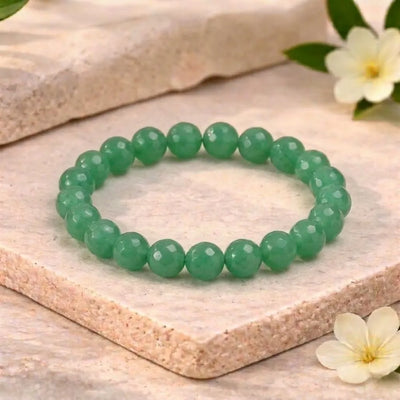
Quick answer: Green aventurine is a variety of quartz coloured by tiny plates of fuchsite, a chromium-bearing green mica, which give it a soft internal sparkle called aventurescence. To check it is real, tilt a bead under a lamp: genuine stone shows uneven internal glitter, dyed quartz shows flat colour with dye in cracks and drill holes, and glass looks perfectly uniform, often with air bubbles.
Green aventurine is one of the most widely sold green stones in India, and also one of the most widely imitated. Most pages will tell you what it is for. This one tells you what it is — what it is made of, why it glitters, where it comes from, and how to check that the bracelet in your hand is the real mineral rather than dyed quartz or coloured glass.
What Green Aventurine Actually Is
Green aventurine is a variety of quartz. What makes it green is not the quartz itself — pure quartz is colourless — but millions of tiny plate-like mineral inclusions trapped inside it. In green aventurine those inclusions are usually fuchsite, a chromium-bearing variety of muscovite mica. The chromium is what gives fuchsite, and therefore the stone, its green colour. Deeper or more saturated greens generally mean more fuchsite in the mix.
Because it is quartz, green aventurine sits at about 7 on the Mohs hardness scale. In practice that means it will not be scratched by a steel knife blade or by ordinary household dust, which is why it holds a polish well and works as an everyday bracelet bead. It is harder than glass, which is typically around 5.5.
Aventurine is not always green, either. The same quartz-with-inclusions structure produces blue and grey aventurine (with dumortierite inclusions) and orange to reddish-brown aventurine (with hematite or goethite). Green is simply the most common and the most traded.
Aventurescence: The Glitter, and Where the Name Comes From
Pick up a green aventurine bead and tilt it slowly under a lamp. You should see a soft internal sparkle move across the stone — not a surface shine like polish, but tiny flashes that appear to sit inside the bead and travel as the angle changes. This optical effect is called aventurescence, and it happens because each flat fuchsite platelet acts as a miniature mirror, catching and throwing back the light as it lines up with your eye.
The effect is important enough that it named itself: aventurescence is the term mineralogists now use for this kind of internal glitter in any stone, and it was borrowed from aventurine. The word traces back to the Italian a ventura — by chance — after a Venetian glassmaker's accidental batch of sparkling glass. The stone gave the whole optical phenomenon its name.
Two practical notes. First, aventurescence is uneven by nature — some beads on a strand will flash more than others, because the platelets are not evenly distributed. That is a sign of a natural stone, not a defect. Second, you need direct, point-source light to see it. Under flat overhead lighting or in a photograph, real aventurine can look disappointingly plain.
How to Tell Real Green Aventurine From the Fakes
The shimmer is the test. Everything sold in place of green aventurine fails it in a characteristic way.
1. Dyed green quartz or dyed quartzite
The most common substitute. It is real quartz, so it is the right hardness and the right weight, but the green is surface dye rather than fuchsite inclusions. Tilt it and there is no internal sparkle at all — the colour looks flat and dead. The giveaway is at the surface: dye pools and darkens in cracks, pits and around the drill hole, so you see concentrated green lines where the stone was porous, against a paler body. Real aventurine has no such concentration, because its colour comes from inside.
2. Green glass
Cheaper again. Glass gives itself away by being too perfect: the green is completely uniform bead to bead and through each bead, with none of aventurine's natural cloudiness or variation. Hold it to a light and look for trapped air bubbles, round or elongated — a dead certain sign of glass, since bubbles cannot form in a natural quartz. Glass also warms up in your hand faster than quartz does, and being softer (around 5.5) it picks up scuffs on the bead surface with wear.
3. "Goldstone" — sold alongside it, not related to it
You will often see a strongly glittering brown-gold or blue-green bead sold on the same table as aventurine, sometimes labelled "goldstone" or, misleadingly, "gold aventurine". Goldstone is not a stone. It is man-made glass with copper particles suspended in it, and its sparkle is far brighter, denser and more regular than any natural aventurescence — it looks like glitter, because effectively it is. There is nothing wrong with buying goldstone if you like it. There is a great deal wrong with being sold it as a natural crystal.
A quick summary test
- Tilt under a lamp: soft, uneven, internal sparkle = aventurine.
- Flat colour, dye caught in cracks = dyed quartz.
- Perfectly uniform colour, bubbles inside = glass.
- Dense, glittery, unnaturally bright flecks = goldstone (manufactured glass).
Where Green Aventurine Is Mined
The world's principal source of green aventurine is India. The deposits around Mysuru in Karnataka, and material worked out of Tamil Nadu, have supplied the global bead and carving trade for decades — so much so that the stone has long been traded under the name "Indian jade". If you are buying green aventurine in India, you are usually buying a domestically mined stone rather than an import, which is a large part of why it is inexpensive here relative to other quartz varieties.
Smaller quantities come from Brazil, Russia, Chile, Spain and Tanzania, but Indian material dominates what you will actually encounter on the market.
What to Look For When Buying Beads
- An even polish with no dye concentrated around the drill holes.
- Visible aventurescence on at least most of the beads when tilted in direct light.
- Natural variation in green from bead to bead — total uniformity is a warning sign.
- Bead size stated honestly; 8mm and 10mm are the usual bracelet sizes.
The Green Aventurine Crystal Bracelet at Calminds is made from natural green aventurine in 8mm and 10mm beads, hand-strung on elastic, with each strand checked for authenticity before it ships. You can also browse the full crystal bracelet range.
Caring for the Stone
At Mohs 7 green aventurine is durable, but the fuchsite inclusions make it slightly more prone to chipping at the edges than solid quartz. Keep it away from hard knocks, store it in a soft pouch rather than loose with metal jewellery, and clean it with a damp cloth. Prolonged direct sunlight can fade some dyed imitations — another quiet way to find out what you actually bought.
The Practical Questions, Answered Elsewhere
This page is about the mineral. The wearing and handling questions are covered fully in our companion guide, so here they are in brief:
- How to wear and use it: wear it as you would any bracelet, daily or occasionally. Full routines are in the beginner's guide.
- Which hand: tradition places receiving on the left wrist and acting on the right, but there is no rule. The beginner's guide explains the convention in detail.
- How to cleanse it: moonlight overnight or incense smoke is the usual approach; step-by-step methods are in the beginner's guide.
- Who can wear it: anyone, of any zodiac sign, of any gender. There are no traditional restrictions on green aventurine.
Its Traditional Associations
In crystal tradition green aventurine is known as the "Stone of Opportunity" and is associated with the heart chakra, largely because of its colour. These are cultural and symbolic associations rather than demonstrated effects: there is no scientific evidence that green aventurine influences health, mood, luck or finances, and it should not be used in place of professional advice of any kind. People wear it because they like the stone and what it represents to them.
Frequently Asked
Is green aventurine the same as jade?
No. It is often nicknamed "Indian jade", but jade is jadeite or nephrite — entirely different minerals. Aventurine is quartz. The nickname is a trade name, and sometimes a deliberate misdescription.
Why do some of my beads sparkle more than others?
Because the fuchsite platelets are not evenly distributed through the rough material. Uneven aventurescence across a strand is normal and is a point in favour of the stone being natural.
Can green aventurine go in water?
Brief contact with water is fine for the mineral at Mohs 7. Prolonged soaking is best avoided, mostly because it degrades the elastic in a bracelet rather than the stone.
Is darker green better quality?
Not necessarily. Darker means more fuchsite, which many buyers prefer, but a paler stone with strong, visible aventurescence is arguably the more characteristic material. Deep uniform green with no sparkle at all is the combination to be suspicious of.
In Short
Green aventurine is quartz coloured by chromium-rich fuchsite mica, hard enough for daily wear at Mohs 7, mined principally in India, and identifiable by the soft internal shimmer — aventurescence — that gave the effect its name. Learn to tilt a bead under a lamp and you will never be sold dyed quartz, green glass or goldstone again.
Shop the products in this guide
Natural stones, free delivery and cash on delivery across India.